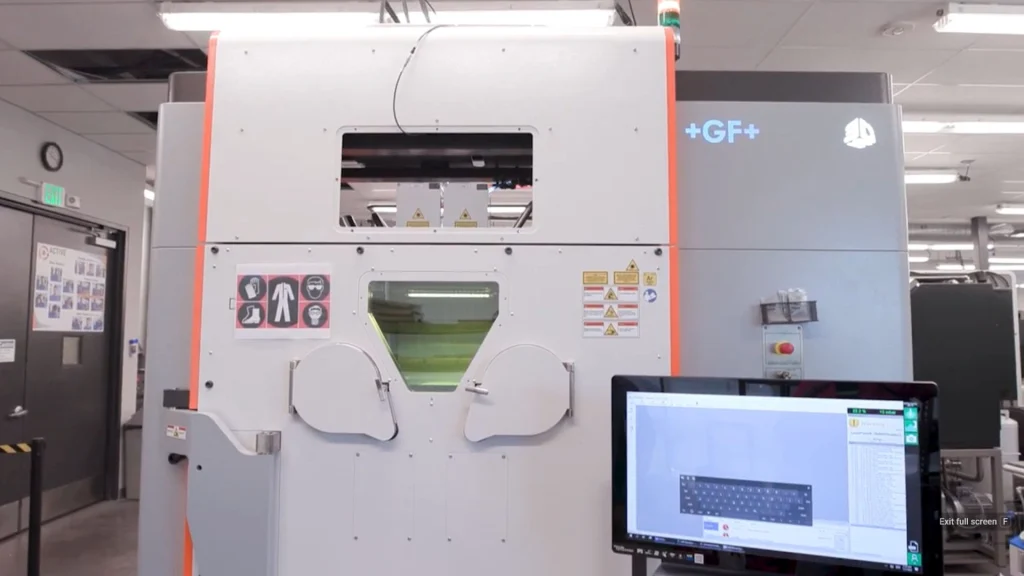
3D Systems has entered into a partnership with the Savannah River National Laboratory (SRNL) to develop advanced 3D printing technologies tailored for use in nuclear energy, critical infrastructure, and national security applications. This collaboration is facilitated through a Cooperative Research and Development Agreement (CRADA) and will take place at SRNL’s Advanced Manufacturing Collaborative (AMC) in South Carolina.
The partnership aims to innovate in areas such as new materials, manufacturing equipment, and integration of artificial intelligence in the additive manufacturing process. Their focus will be on complex components that need to withstand extreme temperatures and radiation. Initial research will explore high-temperature nickel-based superalloys and radiation-tolerant materials, critical for fabricating components like heat exchangers, reactor internals, as well as pumps and valves.
Additive manufacturing offers the capability to produce intricate geometries that are often unachievable with conventional manufacturing methods, while also minimizing material waste and enhancing design freedom. The implications of this collaboration extend beyond just the design of individual components; it aims to bolster the domestic manufacturing capacity of the U.S. and improve supply-chain resilience as the country invests in advanced nuclear technologies.
Moreover, the partnership will delve into the optimization of manufacturing processes using AI and machine learning, providing an opportunity to adjust production parameters intelligently. A critical aspect of this initiative involves establishing a pipeline for workforce development. Researchers and engineers will gain hands-on experience with advanced additive manufacturing systems, preparing a skilled workforce for industries involved in nuclear, aerospace, defense, and energy.
This strategic collaboration comes at a crucial time when the demand for efficient manufacturing methods is increasing, driven by advancements in nuclear technologies. According to the International Energy Agency, global capacity for small modular reactors could reach around 40 GW by 2050, or even 120 GW in an accelerated adoption scenario. The ultimate goal for 3D Systems and SRNL is to transition additive manufacturing from experimental stages to a repeatable, industrial production standard, moving towards a future where innovation in energy systems can be rapidly realized.