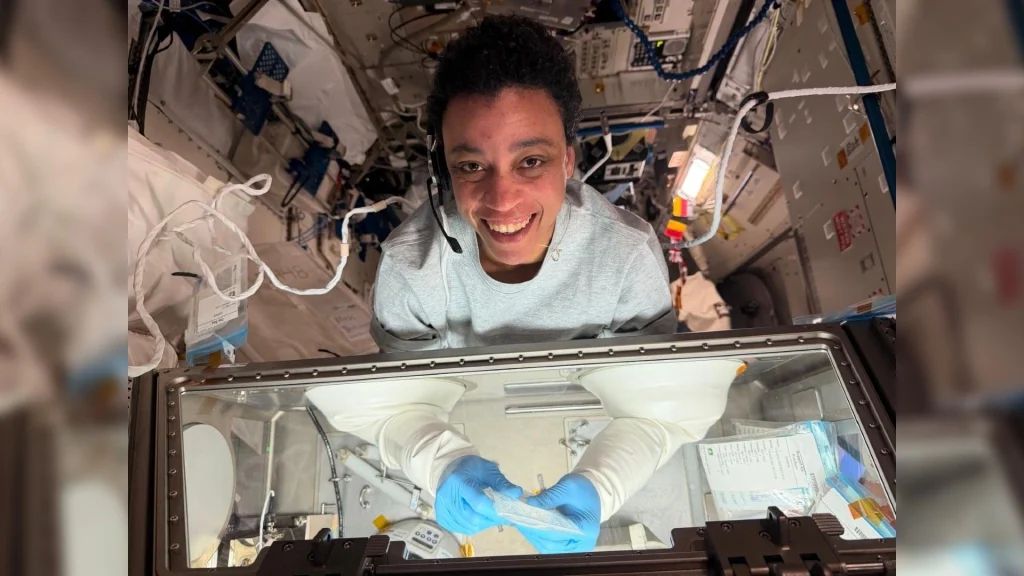
On the International Space Station, NASA astronaut and Crew-13 commander Jessica Watkins is helping researchers explore how microgravity can make it possible to 3D-print human cells and tissues.
The experiment, called InSPA-Auxilium Bioprinter-Cell Printing, takes place inside the station’s Life Sciences Glovebox. In a photo taken by crewmate Anil Menon, Watkins works with samples of living cells, mixing them with bioink before loading the mixture into a specialized cartridge.
The research uses the station’s microgravity environment to investigate printing cells and producing human liver, kidney and cartilage tissue. Researchers hope the work will eventually benefit patients both in space and on Earth.
Although the ISS is not free of gravity, it is in continuous freefall around Earth. This creates a weightless environment that lets scientists study biological processes in conditions that are difficult to reproduce on the ground.