DLP 3D printers depend on an optical engine to project light and cure material layer by layer. Chinese company Litronics designs these systems for printer manufacturers, specializing in engines that pair a digital micromirror device (DMD) with a laser.
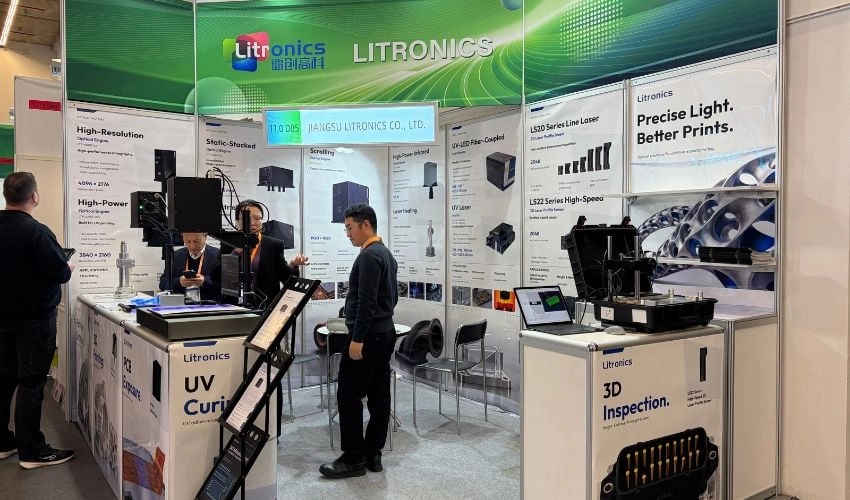
The company is making its first appearance at Formnext, where it is presenting its optical engines, laser sources and measurement tools.
From laser research to optical engines
Litronics CEO Wenhong Gao began researching laser speckle reduction during his PhD in Norway in 2008. After completing his doctorate, he spent several more years developing laser imaging technology.
The work suggested a practical opportunity: provide imaging systems to equipment manufacturers, helping them develop products such as laser direct imaging equipment for high-resolution lithography. Gao founded Jiangsu Litronics in 2016.
Today, the company supplies UV and near-infrared (NIR) DLP optical engines, LED and laser light sources, laser area-heating lenses, and line laser profilers for 3D measurement. Its customers include manufacturers of 3D printers for medical and dental, jewelry and industrial applications, as well as makers of lithography equipment. Litronics says its team includes five PhDs and more than 50 engineers, and that it holds over 120 patents in optics and laser technology.
The role of the optical engine
DLP printing uses a chip called a DMD, which contains hundreds of thousands—or even millions—of tiny micromirrors. Each mirror represents a pixel. By tilting in different directions, the mirrors create an image of a complete layer, which is projected onto resin or another photosensitive material.
The optical engine combines the light source, beam-shaping optics, DMD chip and projection lens. Lasers can provide more power than LEDs, but their coherent light can produce speckle: a grainy interference pattern that leads to uneven illumination. In 3D printing, that unevenness can affect how a layer is exposed. Speckle reduction was the focus of Gao’s early research.
According to Gao, laser-based DLP engines can offer higher precision, stronger contrast and greater production efficiency.
Engines for different materials and applications
Litronics offers engines with wavelengths of 365, 378, 385, 405, 435 and 455 nanometers, as well as NIR systems. The company says these can be used with resin, ceramic and nylon printing. Its infrared engine is designed to sinter powder materials area by area.
The engines support three projection modes:
- Static: projects an entire layer at once.
- Scrolling: moves the projection across a larger surface.
- Tiling: combines multiple images to create a larger projected area.
The company’s systems vary in chip size and intended use. A 0.78-inch engine paired with a 405 nm laser can be used to print elastomer footwear materials in large formats. These resins often contain fillers and pigments that absorb UV light, increasing the power needed for curing. Litronics says its large-format engines can cover areas up to 576 × 324 mm—enough to print several soles at once—and can extend beyond 1,000 mm through tiling.
A 0.95-inch scrolling engine is aimed at large, high-resolution ceramic parts, while a 0.99-inch engine is designed for ultra-high-resolution applications.
Manufacturers can customize the lenses and light-source output. The optical engine and laser source are separate modules, which the company says can simplify maintenance. Litronics also makes profilers for measuring parts, allowing it to connect printing with inspection.
Formnext debut and market outlook
At Formnext, Litronics is displaying static, scrolling and high-resolution optical engines alongside UV laser sources, a line laser profiler and laser area-heating lenses. The lenses turn a laser beam into a uniform heating zone that can preheat powder beds in processes such as selective laser sintering and selective laser melting, helping reduce warpage.
Most of the company’s current products are intended for non-metal materials, though it is developing optical engines for metal printing.
Gao describes the additive manufacturing market as “stratifying” rather than rapidly exploding. In his view, consumer-focused companies compete on scale and cost, while industrial manufacturers prioritize reliability and adaptability to production.
More information is available from Litronics.