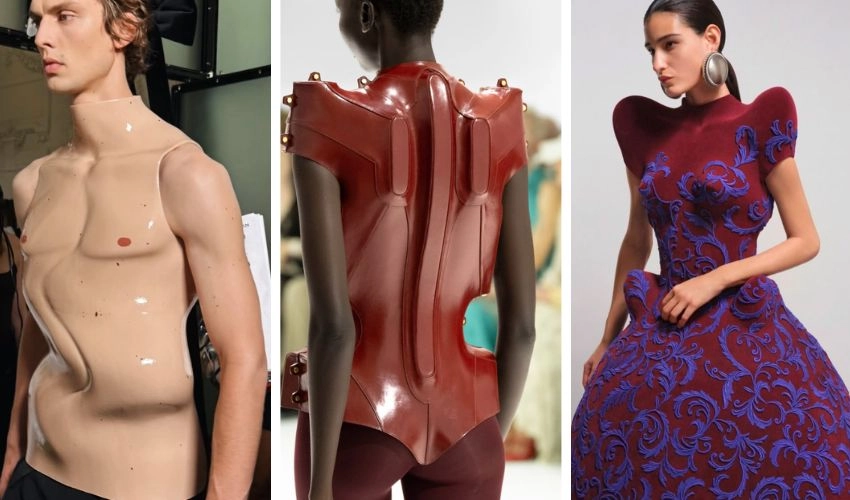
Jean Paul Gaultier has embraced the cutting-edge world of additive manufacturing for his latest Autumn/Winter 2026-27 haute couture collection, presented in Paris in July. This collection marks Duran Lantink’s debut as the creative director of the fashion house, who is known for creating garments that redefine conventional silhouettes. Among the striking designs are a sculptural bust reminiscent of a surrealist painting and an exoskeleton inspired by the feathered serpent.
The collection’s unique 3D printed pieces were developed by designer ROMI in collaboration with the French printing service Sculpteo. These items were crafted using materials like PA12 and flexible TPU, employing advanced printing technologies like HP Multi Jet Fusion (MJF) and Selective Laser Sintering (SLS).
Highlights of the 3D Printed Looks
-
Look 7: This deformed bustier was printed in raw TPU and then underwent a meticulous finishing process that involved sanding, priming, and multiple latex dips to achieve a realistic appearance, complete with hand-painted freckles and separately cast latex nipples.
-
Look 11: Showcasing a 3D printed guipure dress, this ensemble featured both the bodice and the domed skirt produced using 3D printing, with fiber painstakingly applied to the surface by artisans.
-
Look 19: A standout piece made from individual PA12 scales, each printed and sewn by hand, allowing for a garment that mimics the overlapping structure of snake scales, offering both visual intrigue and fluid movement.
-
Look 26: This design began with a 3D scan of the model, which was then transformed into a fantastical torso adorned with protruding shapes. The printed sections were combined into a cohesive exoskeleton, later embellished with pink feathers by expert plumassiers.
-
Look 32: This burgundy bodysuit featured a 3D printed core around which leather was meticulously crafted into a stylish armored shell. The leather underwent a complex hand-dyeing process to achieve its rich hue.
The Role of 3D Printing in High Fashion
The incorporation of 3D printing technology allowed Gaultier to create complex geometries that would be infeasible using traditional garment construction methods. The precision and speed of 3D printing not only contributed to the innovative shapes of the designs but also streamlined the production process, allowing for a rapid turnaround without sacrificing craftsmanship.
This collaboration exemplifies how fashion and technology can intersect to elevate creativity within haute couture, paving the way for future explorations in the realm of wearable art.