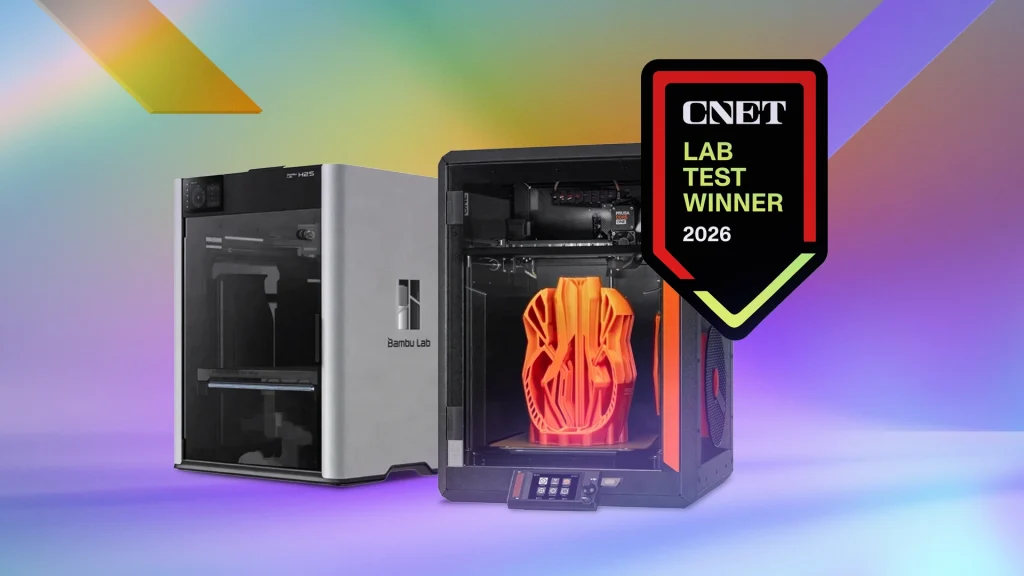
3D printing is often perceived merely as a way to create novelty items like flexi-dragons and keychains. However, it serves as a significant manufacturing tool capable of producing high-quality prints suitable for various applications. During extensive testing, accuracy emerged as a vital factor in 3D printing, with CNET developing a proprietary model to evaluate this attribute across different machines.
Key Findings
- The Prusa Core One showcased an accuracy variance of just 0.18%, closely followed by the Prusa MK4S at 0.19%.
- Higher prices usually correspond to greater accuracy in 3D printers.
- The Orange Storm Giga surprised testers with its accuracy but struggled with complex prints.
Importance of Accuracy
In the realm of Fused Deposition Modeling (FDM) printers—which use hard plastic filament—the accuracy denotes how precisely a printer can replicate the dimensions of a 3D model. Many factors can contribute to inaccuracy, including mechanical issues and filament flow rates.
Factors Influencing Accuracy
-
Firmware and Build Quality: A printer’s reproductive accuracy is impacted by the quality of its components and how well they are constructed. Maintenance, like lubricating rods and replacing nozzles, significantly affects performance.
-
Extrusion and Filament Variables: The solid plastic filament’s interaction speed through the nozzle can disrupt accuracy. Variations in temperature and humidity also play crucial roles in print reliability.
-
Thermal Management: External factors can influence the material after extrusion. Heating elements like build plates can minimize shrinkage and help maintain accurate dimensions.
Performance Paradox
Interestingly, while speed is an aim for many modern printers, it should not always compromise accuracy. Some manufacturers, like Bambu Lab, prioritize fast printing speeds, while others, like Prusa, focus on delivering dimensional accuracy over rapid output.
Testing Methodology
CNET evaluates 3D printers over a minimum of 100 hours, using a test model designed to challenge various printing capacities. Tests focus on metrics like bridging quality, overhang performance, and ringing, but the core metric is accuracy.
Home Accuracy Checks
For those wishing to verify their printer’s accuracy, one can use a standard such as the CNET test model or the widely recognized Benchy model. Essential tools like digital calipers provide precise measurements.
Recommendations
Here’s a summary of top printers based on recent accuracy tests:
- Prusa Core One: Leading with just 0.18% accuracy, it is ideal for serious users.
- Prusa MK4S: A close contender with 0.19% variance, equally impressive.
- Bambu Lab H2S: Offers a good mix of speed and accuracy at 0.22% variance.
For those on a budget, options like the Bambu Lab A1 Combo with 1.11% variance and Elegoo Centauri Carbon 2 Combo at 1.20% still deliver reliable performance.
In summary, while numerous printers are available, carefully weighing factors like accuracy, speed, and quality will guide you to the best choice for your 3D printing needs.