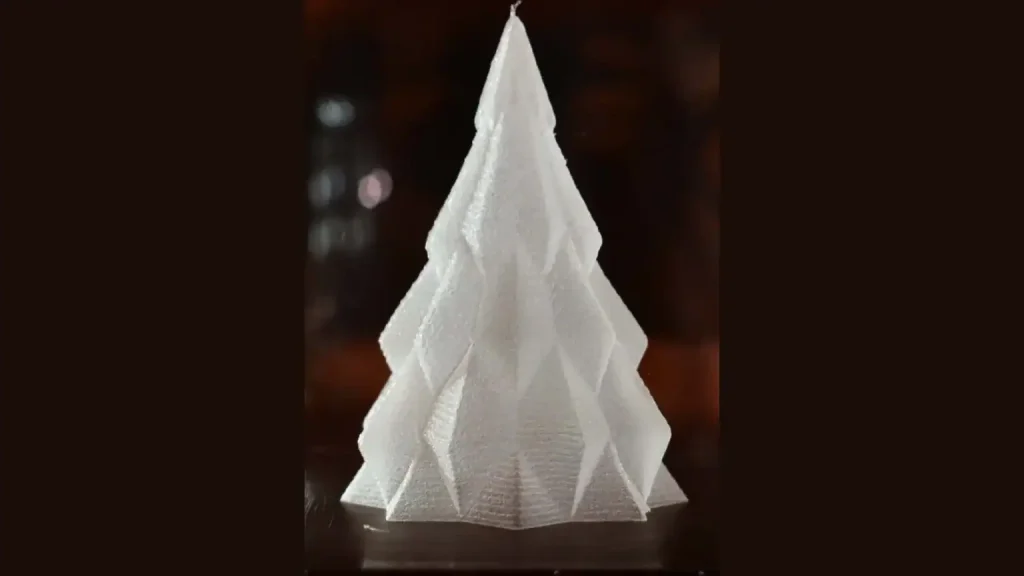
In a groundbreaking study from the University of Amsterdam, physicists have developed a method to 3D-print ice at room temperature, using a simple vacuum chamber. By applying a jet of room-temperature water, they created a situation where water droplets quickly freeze upon exiting the nozzle, allowing for the construction of various intricate shapes such as tiny Christmas trees, tilted pillars, and even the contour of a human face—all without the need for refrigeration or external supports.
The process relies on a principle known as evaporative cooling, where water molecules escape rapidly from liquid, cooling the remaining water. This method allows the water jet to reach below freezing temperatures almost instantaneously in a vacuum, which facilitates the formation of ice as the droplets hit the newly forming structure.
The researchers, led by Menno Demmenie, Stefan Kooij, and Daniel Bonn, first discovered the potential of this technique by accident when they were experimenting with spraying water in a vacuum to reduce air drag. They began to test this with a modified 3D printer, which led to impressive results.
The team was able to form an ice Christmas tree measuring 8 centimeters in height and 6 centimeters in width in just 26 minutes. High-speed videos captured the freezing process, showing that droplets remained liquid briefly and merged before solidifying into ice, a process aided by water’s surface tension.
Further refinement in their printing approach enabled the team to quickly create a six-centimeter tall human profile in just eight seconds, demonstrating the versatility of the technique, which can achieve angles as shallow as 14 degrees relative to the surface.
While the concept of 3D printing ice is not new, the unique application of vacuum-driven evaporation marks a significant advance over existing methods that rely on extremely cold platforms, allowing for faster production without refrigeration.
This innovative approach has promising applications beyond just decorative items. The researchers envision it being employed for creating disposable molds for microfluidic channels and tissue scaffolds, which typically require complex architectures resembling blood-vessel networks. Additionally, the technique may find utility on Mars, where water ice is abundant, allowing for the potential construction of structures using local resources without the need for cumbersome refrigeration equipment.