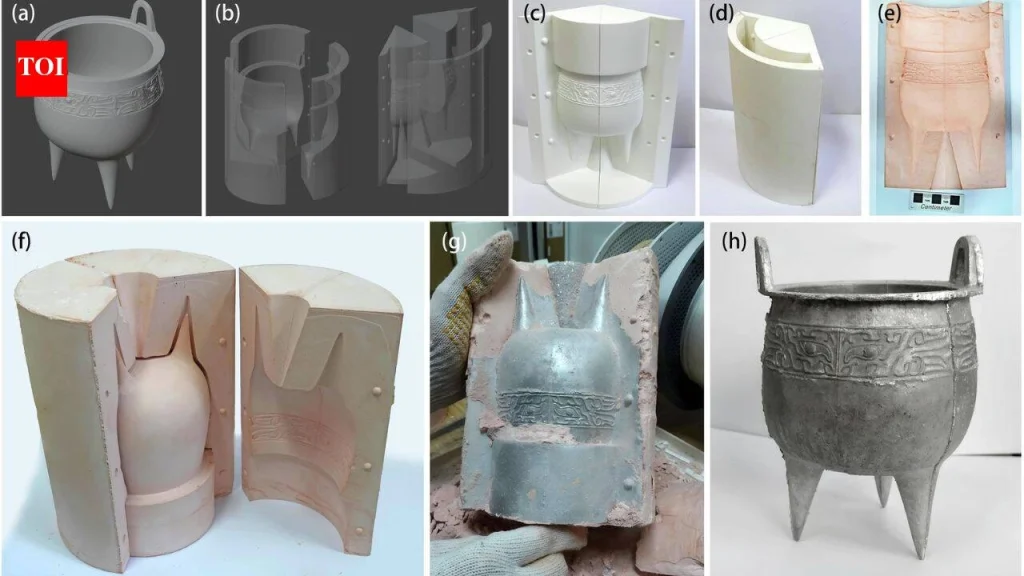
Researchers have successfully recreated an ancient Chinese bronze-casting technique using digital modeling and 3D printing, significantly accelerating the traditional process. Their approach primarily focused on ‘piece-mold casting,’ a method historically used during the Shang and Zhou dynasties in China. Traditionally, crafting such pieces required skilled artisans, extensive manual work, and could extend over weeks to months. With the new method, the time taken reduces to less than 40 hours.
The study was applied to a Shang dynasty-style bronze vessel known as a ‘Ding.’ Instead of seeking to replicate the original craftsmanship exactly, researchers aimed to enhance their ability to test and explore the ancient designs and their assembly processes through a faster experimental method. The findings were published in the study titled Integrated digital casting: a new method for simulating piece-mold techniques of ancient bronzes.
Understanding Piece-Mold Casting
In ancient China, piece-mold casting began by creating a model of the desired object, which was then used to form an outer mold divided into several sections. An inner core was placed within this outer mold, creating a cavity into which molten metal could be poured. The design of these molds was critical, as it determined the final casting’s ability to be successfully assembled and used.
Researchers had previously studied excavated mold fragments and bronze surfaces to glean insights into these ancient techniques. While experimental reconstructions provided valuable data, they were often inconsistent due to dependence on individual craftsmanship and environmental conditions.
Digital Reconstruction Process
The new method utilized a digital model of a ‘Shang dynasty Ding.’ Researchers used computer modeling software to divide the vessel digitally into separate sections for the outer mold and the inner core, incorporating alignment features for accurate assembly. These digital designs were then transformed into physical mold negatives through 3D printing, establishing a standardized starting point for reconstruction.
During traditional reconstruction, creating a single mold set could take up to 50 days due to the rigorous stages involved: modeling, mold preparation, carving, and curing processes, each demanding high precision and favorable environmental conditions. The challenge was compounded by the need for high firing temperatures and the careful management of molten metal, making repeated experiments costly.
Use of Substitute Materials
Instead of attempting to replicate every material and environmental condition used by ancient craftsmen, researchers opted for materials that maintained dimensional accuracy while facilitating faster production. They poured a low-density gypsum mixture into the 3D-printed negatives to form the outer mold sections and the core, which set more quickly than traditional clay. A low-melting-point alloy was then poured, bypassing the challenges associated with high-temperature bronze pouring.
The researchers clarified that the chosen substitute materials were not claims that ancient craftsmen used similar substances; rather, they served as tools for testing hypotheses about mold design.
Results and Implications
The final castings produced through this digital-assisted method preserved vital characteristics of traditional piece-mold casting, such as casting joints and mold markings. The research demonstrated that this digitally integrated process allowed for better control over variables like wall thickness and mold assembly precision.
The primary advantage of this method is the substantial reduction in experimental cycle time, from weeks to under 40 hours. This increase in efficiency allows researchers to explore various mold configurations and assembly techniques without dedicating significant time to each test.
Furthermore, by simplifying the reconstruction process, the method holds educational potential, enabling a broader audience, including students and museum visitors, to engage with the principles of this ancient Chinese manufacturing practice.
This innovative approach combines modern technology with traditional craftsmanship, paving the way for greater understanding of historical techniques that have remained enigmatic for centuries.