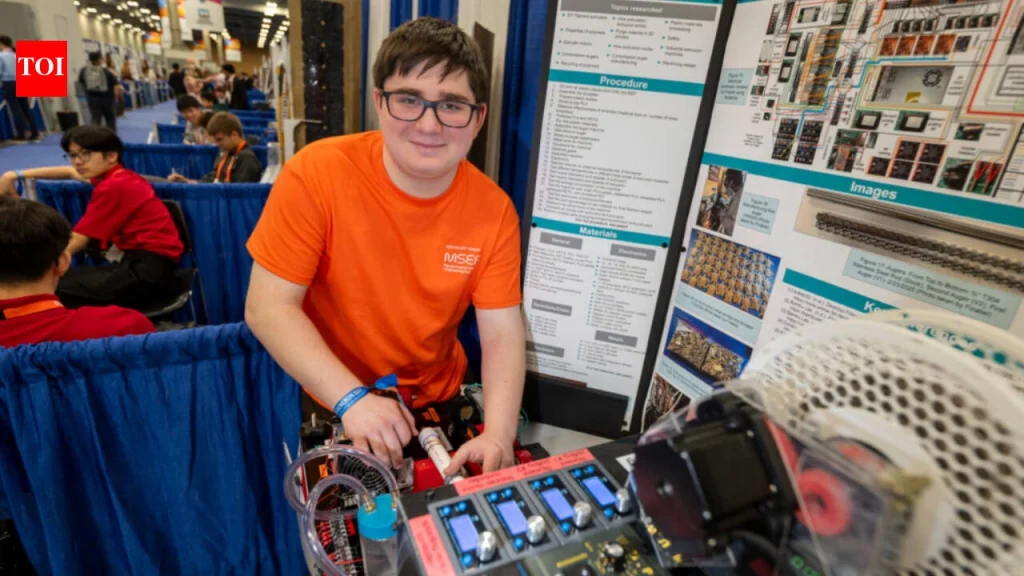
Benjamin Davis, a 16-year-old student from Massachusetts, has created an innovative machine designed to recycle waste from 3D printing. His project transforms discarded 3D printing plastic into reusable filament, addressing the environmental issues linked to plastic waste in the 3D printing industry.
Typically, when a 3D print fails, the remnants—such as tangled filament or poorly shaped products—are thrown away. However, Davis recognized these scraps as valuable resources. After dedicating over 800 hours and completing approximately 50 iterations of his design, he developed a small recycling system that converts these waste plastics back into filament usable for new prints. This machine employs two processing methods, pultrusion and extrusion, making it about 45% more efficient than existing methods used in isolation.
Davis’ innovative machine not only recycles material but is also designed with practicality in mind. It produces high-quality filament at a fraction of the cost of commercial recycling machines, potentially making small-scale recycling more feasible for schools, hobbyists, and personal creation spaces.
3D printing has become widespread, but it often results in significant waste. Studies indicate that up to 67% of the filament can be wasted during standard printing processes. Davis’s machine offers a solution by enabling users to recycle materials from failed prints, integrating them back into the production cycle. This aligns with a growing movement towards sustainable manufacturing practices.
His project was showcased at the Regeneron International Science and Engineering Fair (ISEF) in 2025, where he earned the Regeneron Young Scientist Award, valued at $75,000. The recognition not only highlights the environmental impact of his work but also its practical applications concerning efficiency, ease of use, and cost.
Davis plans to further explore mechanical and materials engineering in college, inspired by his venture into recycling and advanced manufacturing. His machine encapsulates a significant concept: the plastic waste generated during 3D printing can have a second life, engaging in a cycle of reuse rather than disposal.