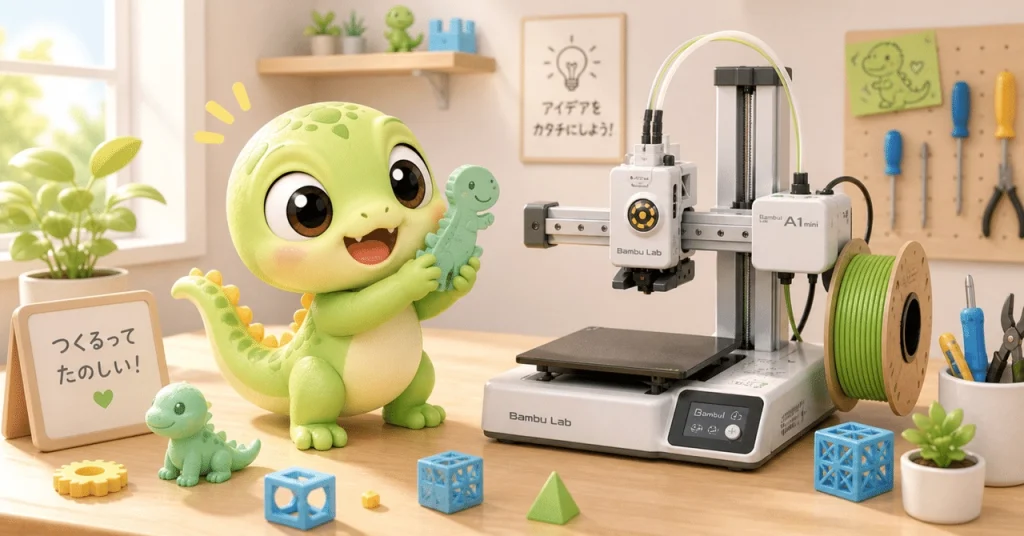
Before buying a 3D printer, I imagined that I could simply prepare a design, press a button, and watch the machine make whatever I wanted. After bringing a Bambu Lab A1 mini home and using it with my sixth-grade child, I realized the experience was about much more than the finished objects.
Printing takes time and attention
A 3D printer doesn’t turn data into an object instantly. Print times can be long, and the process requires some supervision. Before a print begins, you need to check the settings, then monitor its progress in software such as Bambu Studio.
It felt less like adding a convenient appliance to the house and more like taking on a new task.
Things don’t always go to plan
Prints can fail. Filament may get stuck to the nozzle, wasting both material and the time spent printing. Even after a successful print, removing the support material can be tricky—and sometimes the object breaks in the process.
These setbacks have taught me to check things carefully and pause to assess the situation rather than react in a hurry.
The process can be as fascinating as the result
My child was interested not only in what the printer made, but in watching it happen. Layer by layer, filament builds up, and a design on the screen becomes something tangible.
They also found the leftover material from color changes fascinating. As a parent, I saw waste that needed to be stored or thrown away; my child saw interesting colors and shapes. It reminded me that children and adults can look at the same thing and notice entirely different details.
Making requires thinking
A 3D printer needs a design. You can use existing files, but making your own idea means learning to use 3D CAD software such as Autodesk Fusion.
A shape that looks right on screen may not work as a real object. You have to consider its size, form, and usefulness, then rethink the design if the print doesn’t turn out as expected. I didn’t start with the goal of making the experience educational. But when there’s something you want to create, you naturally start learning how to design it, test it, and improve it.
A printer doesn’t make someone an expert overnight
Buying a 3D printer won’t automatically turn a child into a skilled maker. Printing takes time, failures happen, and designing requires practice. There are also materials to manage and cleanup to do, so parents may need to help.
Still, for a child who enjoys making things, it can be an engaging tool. Ideas that begin on a screen become objects you can hold.
Before buying one, it may be worth considering not only how many things it can produce, but whether your child might enjoy the process of making them. For us, that process—checking, experimenting, failing, and watching an idea take shape—has become a big part of the appeal.