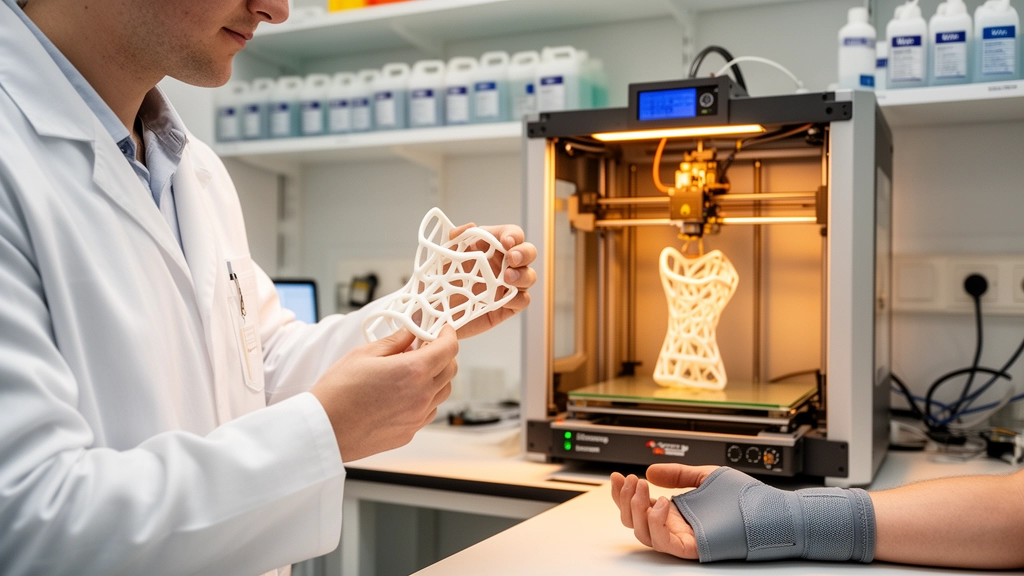
Millions of people with broken limbs are treated with plaster or thermoplastic casts. Although casts keep bones stable while they heal, they can be heavy, itchy and uncomfortable. They also trap moisture and make it difficult to keep skin clean or access wounds.
Researchers at Radboud University Medical Centre in the Netherlands have published a practical roadmap to help hospitals produce lightweight, patient-specific splints in house using 3D printing. The study, led by L. A. van Ginkel of the Radboudumc 3D Lab, describes how a trauma center can move from an initial concept to a service that works in routine care.
Benefits—and challenges—of custom splints
A 3D-printed splint can be designed from a digital scan of a patient’s anatomy, allowing it to fit closely while weighing less than a conventional cast. Its open structure lets air reach the skin, potentially reducing moisture and irritation. It can also leave wounds accessible for dressing changes, inspection and treatment without removing the entire device.
Despite these potential advantages, such splints are not yet common in everyday clinical practice. Hospitals must choose suitable scanners, design software and printers, while ensuring the equipment can reliably produce devices to appropriate standards. They also need to integrate each step—from scanning a patient to delivering the finished splint—into the fast pace of acute care.
Regulation adds another layer. Under the European Medical Device Regulation, a hospital making devices for use in-house takes on responsibilities as a manufacturer, including requirements for documentation, production quality and traceability.
Building the roadmap in a real trauma center
The research team developed its guide through implementation work at a level-one trauma center in the Netherlands. Multidisciplinary workshops brought together trauma surgeons, 3D-lab staff and other stakeholders to identify practical barriers and discuss how to address them.
The discussions covered technical and organizational issues, including how patient scans move from the emergency department to design staff, who is responsible for equipment maintenance, what software and licenses are needed, and how each finished device should be documented.
Researchers organized these challenges into categories and translated them into a sequence of implementation steps. Each step identifies the stakeholders involved and the actions required. The resulting guide is intended to help hospitals plan equipment selection, clinical workflows, regulatory compliance and the organizational support needed to sustain production—not just launch a one-time pilot.
The roadmap incorporates regulatory requirements from the outset, rather than treating them as paperwork to be added after production begins. The team also asked potential end-users to review the guide through a questionnaire, assessing whether it was clear and practical for clinical and technical staff.
The authors say the framework can support implementation in both research and routine clinical practice. For hospitals, the central lesson is that success depends on coordinating decisions about staffing, scanning, software, production, training, data handling and quality documentation before the service is established.
Patient-specific splints may also offer a starting point for broader hospital-based manufacturing. The capabilities developed for producing them—reliable workflows, quality systems and regulatory processes—could support the creation of other customized medical devices in the future.
Study: An implementation roadmap for in-house production of patient-specific 3D printed splints in an acute care setting, published in 3D Printing in Medicine.