A small electrostatic discharge can damage sensitive electronic components. Static electricity builds up on an object and transfers to another, sometimes as a tiny spark. While typically harmless to people, it can disrupt or damage electronics.
Standard filaments such as PLA and PETG are electrical insulators and can accumulate static charge. Protopasta offers specialty filaments with either conductive or static-dissipative properties for electronics projects and electrostatic-discharge (ESD) control.
Conductive and dissipative filaments: what’s the difference?
Electrical resistance measures how strongly a material opposes the flow of current. Insulators have high resistance, while conductive materials have low resistance. Dissipative materials fall between the two: they release electrostatic charge gradually and in a controlled way.
Conductive filament can be used in low-voltage circuits and touch sensors. Dissipative filament is intended for parts that help protect sensitive electronics from static discharge, including holders and handling tools. A conductive material is not automatically the right choice for ESD protection; the best option depends on the part’s purpose and required electrical properties.
Conductive filament for circuits and touch sensors
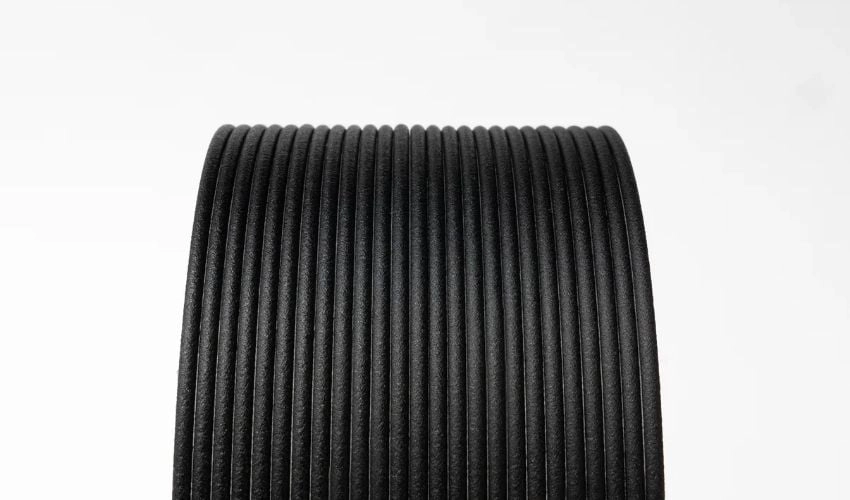
Protopasta has developed conductive filaments for more than a decade. Its Electrically Conductive Composite PLA, also known as Conductive PLA, uses carbon black to change PLA’s electrical properties.
The material can act as a resistor in low-voltage circuits, supporting projects such as LED circuits and capacitive touch sensors. For instance, a printed part can serve as a touch-sensitive button when connected to suitable electronic components.
Dissipative filament for electronics work
For applications where static control is the priority, Protopasta offers three dissipative filaments based on its conductive PLA: Static Dissipative PLA, Static Dissipative Carbon Fiber PLA, and Static Dissipative PETG. These materials are less conductive, with higher resistance that makes them better suited to reducing ESD risk.
All three have a specified surface resistance of between 10⁴ and 10⁶ Ω, a range used for ESD applications. They can be used to print parts such as trays, PCB holders, assembly jigs, and enclosures for use around electronic components.
The choice among them depends on the desired mechanical properties and base material. Dissipative PLA suits users who prefer printing with PLA. The carbon-fiber-reinforced version is stiffer and has a distinctive finish, but requires a wear-resistant nozzle. Dissipative PETG offers the properties of that polymer.
Protopasta says the filaments print much like standard PLA or PETG on popular desktop printers. Since June 2026, the company has supplied its materials on in-house-made spools with recyclable plastic sides and a cardboard core. The spools are compatible with standard automatic filament switching systems.
Controlling material properties
The difference between conductive and dissipative filaments comes down to formulation. Protopasta uses carbon black to adjust electrical resistance, with the type and amount of additive influencing the final properties.
The company sources its ingredients separately, combines them in-house, and produces its own pellets. This gives it control over the formulation, according to co-founder Alexander Dick. Protopasta also checks the materials’ electrical resistance with dedicated instruments to confirm it falls within the intended range.
Resistance in a printed part can vary with the printer, print settings, and part orientation. Protopasta says these variations do not affect the parts’ suitability for ESD applications.
The same manufacturing approach allows the company to combine plastics with other materials. Its Magnetic Iron PLA contains iron particles, while High Density Stainless Steel HTPLA contains 70% 400-series stainless steel. Both are ferromagnetic; the stainless-steel material can also be brushed or polished to create a metallic finish. Advanced users may combine magnetic and conductive filaments in a project.
Protopasta’s range is aimed at designers, engineers, technicians, hobbyists, and manufacturing professionals looking for filaments with electrical functions. See the conductive and dissipative filament collection.