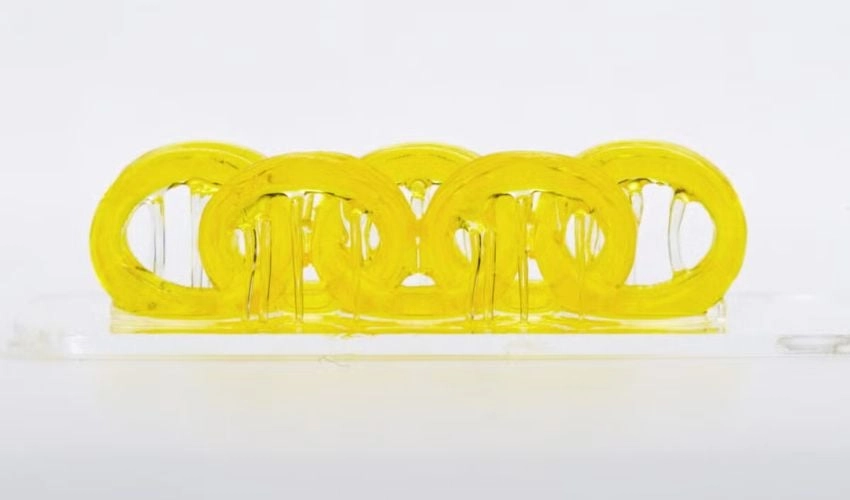
This summer, researchers from the University of Texas at Austin unveiled a groundbreaking advancement in 3D printing that has significant implications for the future of medical devices and flexible electronics. Supported by funding from entities like the US Department of Defense and the National Science Foundation, the team developed a novel method for integrating hard and soft structures into a single printed object, drawing inspiration from natural materials like bone and cartilage. This technique facilitated the creation of a fully functional knee joint mini-model using a 3D printer.
Unlike traditional 3D printing methods that typically rely on filament, this new approach employs a liquid resin that cures in response to two light pulses. Ultraviolet light solidifies areas into hard, plastic-like forms, while violet light creates elastic, rubber-like regions. This allows for smooth transitions between rigidity and flexibility within one component.
Zak Page, an assistant professor at UT Austin, explained that the technology involves chemically cross-linking molecules, enhancing the strength at the interface where soft meets hard materials. He elaborated, "We built in a molecule with both reactive groups so our two solidification reactions could ‘talk to each other’ at the interface. That gives us a much stronger connection between the soft and hard parts, and there can be a gradual transition if we want."
In addition to the knee joint, this method has been trialed in other applications, such as creating a stretchable electronic strip that integrates a gold conductor, ensuring flexibility despite comprising harder ligament sections. The approach not only proves faster and more effective than previous techniques but also promises ease of replication and affordability, making it accessible for researchers, hospitals, and educators. Keldy Mason, a PhD student in Page’s lab, noted that this method could potentially make 3D printing more competitive for high-volume production when compared to established processes like injection molding, while simultaneously expanding design opportunities.
The ability to merge biological functionality with robust mechanical characteristics holds immense potential, paving the way for advancements in medical implants, wearable electronics, and soft robotics. With its precision, scalability, and cost-effectiveness, this innovative 3D printing technology is on the brink of entering practical application. For more detailed information, you can follow this link.