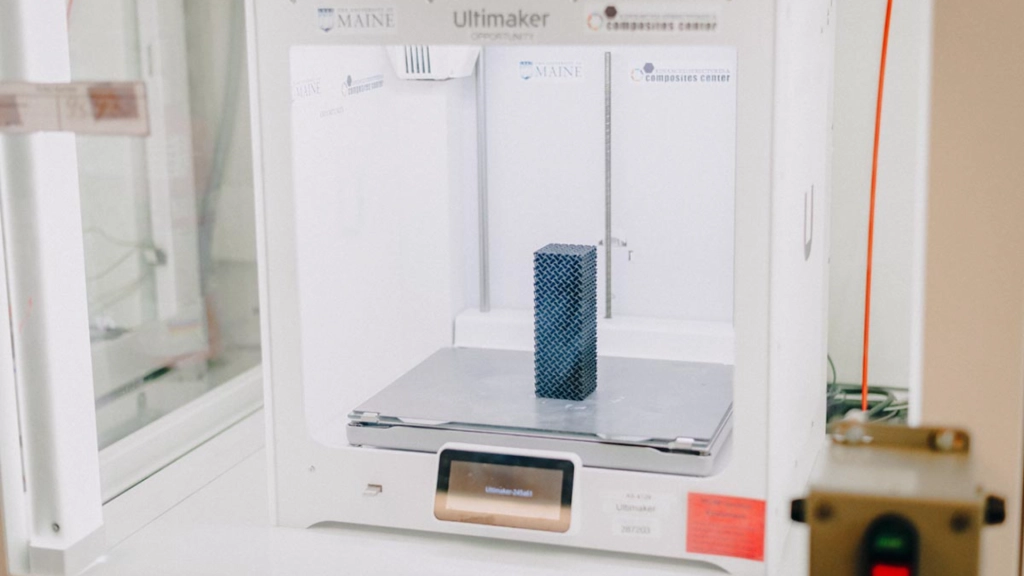
New research from the University of Maine aims to improve the reliability of lightweight 3D-printed components by enhancing strength predictions during their design phase. The team, led by research engineer Philip Bean alongside professors Senthil Vel and Roberto Lopez-Anido, is exploring a novel method to give engineers a better understanding of material performance.
Stress and Lightweight 3D-Printed Parts
The study focuses on gyroid infill, a complex pattern commonly used in 3D printing that efficiently supports weight while maintaining overall strength and stability. The researchers utilized advanced computer modeling combined with practical stress testing to investigate how gyroid infill performs under varying load conditions.
To validate their simulations, the team produced physical prototypes and subjected them to rigorous stress tests, confirming their predictions. This approach allows for straightforward strength assessments, which can aid in making informed design decisions.
Enhanced Performance and Material Efficiency
Unlike traditional models, which often overlook the intricacies of complex internal geometries, this fresh perspective offers insights into how gyroid infill contributes to overall strength and functionality. Armed with this knowledge, engineers can make more effective design choices while optimizing material use.
According to Bean, this research empowers engineers to confidently and accurately design 3D-printed parts, ultimately reducing material consumption without compromising performance. The advancements are anticipated to benefit various sectors that demand robust, lightweight materials, including aerospace, automotive, and medical device manufacturing.
The findings from this study have been published in the journal Progress in Additive Manufacturing.