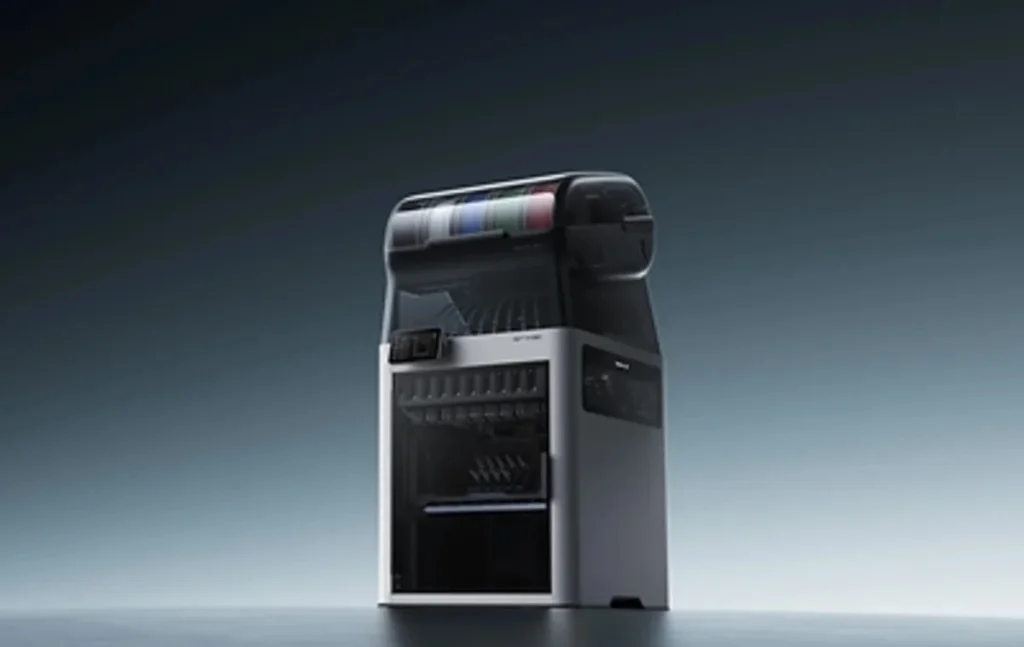
Bambu Lab has introduced the H3C, its first third-generation desktop 3D printer. The machine is built around a nine-tool Swaptek system designed to make multi-material printing faster and simpler.
Unlike printers that must unload and reload filament between materials, the H3C keeps nine independent tools loaded and preheated. It can switch tools in about six seconds, with the next nozzle heating while the current one is still printing. The company says the setup reduces downtime and filament waste.
The printer also includes a retractable guide-tube rack intended to reduce vibration and prevent tubes from interfering with one another. Automatic tool docking, offset adjustments and bed leveling are designed to handle much of the setup without requiring user intervention.
Flexible materials and filament storage
The H3C’s FlexFeed extruder supports both 1.75 mm and 2.85 mm filament. A dedicated path for 2.85 mm TPU is designed to keep the flexible material stable during feeding. Bambu Lab says it can print TPU as soft as 75A at up to three times the flow rate of a conventional printer.
Nine spools are housed in the sealed AMS 3H filament-management system, which protects materials from moisture and feeds them to the appropriate tools. Its drying module can reach 85°C while printing. The system can be expanded to support as many as 24 materials, with additional AMS units available separately.
Speed, temperature and cooling
Bambu Lab says the H3C’s motion platform is 40% lighter than its predecessor, enabling acceleration of up to 25,000 mm/s² and movement speeds of up to 1,400 mm/s. Its hardened-steel nozzles are available in sizes from 0.2 mm to 0.8 mm and are designed for abrasive materials, including carbon-fiber and glass-fiber composites.
The printer’s heated chamber can reach 65°C, while each of its nine tools can reach 350°C. A multi-part cooling system is intended to maintain print quality at high speeds and support materials such as ABS, PC and nylon-based composites.
What the tool system enables
The nine-tool setup is designed to support color blending, different nozzle sizes and combinations of rigid and flexible materials in one print. Bambu Lab says five base filaments—cyan, magenta, yellow, white and black—can be used to create a broad range of colors. Different nozzle sizes can also be assigned to fine details and faster bulk printing within the same job.
The printer is designed to make multi-material workflows accessible through automatic calibration and tool changes. An optional camera accessory provides a second view for monitoring prints.
The H3C AMS Combo is priced at US$2,499, excluding tax, with shipping included, and €2,499 in the EU, including tax. It became available on November 3 through the Bambu Lab Store.