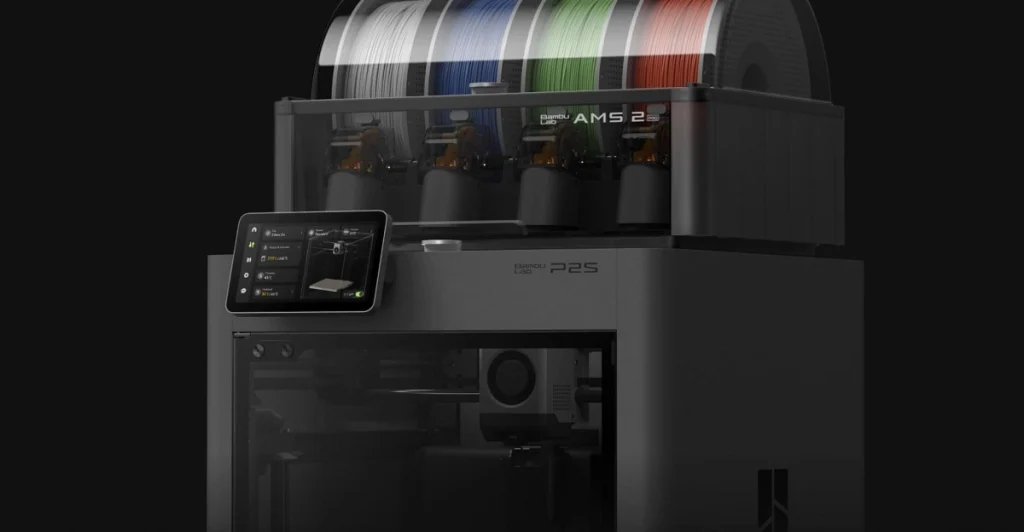
After a year of testing 3D printers—and printing 40,000 whistles—the Bambu Lab P2S Combo is the one I’d recommend to most newcomers. Its automatic filament system, enclosed storage, and straightforward maintenance make it easier to use than many alternatives. It costs $649 on sale through December 1st, or $749 at its regular price.
I tested the P2S alongside several competitors, logging 6,770 print hours across four machines. The P2S stands out for being reliable and convenient: I can send a model from my phone or computer, leave filament loaded in the enclosed AMS, and let the printer calibrate and handle the job.
A multicolor system isn’t just useful for printing objects in several colors at once. It also means you can keep different filaments ready and print with the one you want without manually loading a spool each time. That convenience matters especially because filament exposed to moisture can become brittle and cause jams. The P2S’s AMS keeps rolls protected, while many less expensive printers store filament in the open.
The Elegoo Centauri Carbon 2 Combo is a tempting alternative at $369. In my tests, it produced excellent prints and required little setup. But its exposed filament storage makes it less convenient, and I ran into problems that were harder to diagnose. The original Carbon developed filament-feeding issues; the Carbon 2 stopped leveling after its nozzle struck the print bed. I eventually fixed the latter by disconnecting and reconnecting small connectors inside the bed—not the sort of repair most buyers should need to make.
The P2S has also needed maintenance. Over 1,692 hours, I replaced its nozzle twice, cleaned and lubricated its moving parts, washed its build plates, and cleared a few AMS jams. But replacing the hotend is simple: a spring clip lets you swap it without tools in about a minute. By comparison, repairs on the Elegoo machines can require removing a hot nozzle or taking apart the hotend.
The P1S Combo, which is often available for less, is the P2S’s closest rival. I’ve used a modified P1P for nearly 3,000 hours, and it has been a dependable workhorse. Still, I’ve come to prefer the P2S for its touchscreen, easier hotend replacement, and a collection of small improvements: better build-plate positioning, plate detection, a more effective nozzle wiper, active ventilation, easier cleaning, and a better-lit camera.
None of this makes the P2S maintenance-free. Parts can wear out, filament can jam, and choosing good-quality spools matters. Its AMS 2 can also struggle with some rolls; Bambu has offered free replacement gears for certain units, though installing them requires some technical confidence.
For a first-time buyer, the P2S is a particularly polished and approachable option. It’s the printer I’d buy, though even the best consumer models still require occasional troubleshooting—and someone who wants a completely hands-off experience may prefer to wait a few more years.