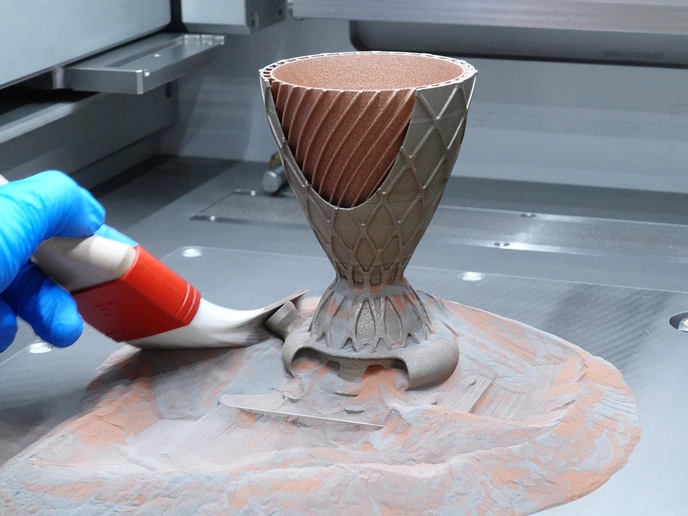
Metal 3D printing has traditionally relied on a single material, limiting its ability to make components that combine properties such as heat resistance, flexibility and strength. Combining different metals can help meet these demands, but mismatched materials often crack under the thermal stresses of printing. Until now, developing reliable multi-metal parts has largely depended on costly trial and error.
The EU-funded MADE-3D project developed a more systematic approach, using computational modelling and machine learning to design and optimise multi-material joints. The team tested its innovations in industrial settings and demonstrated that two challenging aerospace alloys—Inconel 718 and Ti6Al4V—could be joined by 3D printing without defects.
One application is a lightweight rocket nozzle made from nickel-titanium materials, designed to withstand extreme heat while retaining its structural strength. The project reports a weight reduction of about 40% compared with a nozzle made from a single material. Lighter components can reduce fuel use and emissions in aerospace and aviation.
MADE-3D also created a framework covering alloy design, printing-process optimisation, component design, qualification and recycling. By moving multi-material metal printing from experimental trial and error toward predictive engineering, the project aims to make complex components faster and more reliably, with less material waste. Its approach supports European sustainability goals and could help expand multi-material manufacturing across sectors including aerospace, automotive and energy.