Before buying a 3D printer, I imagined a simple process: design an object on a computer, prepare it for printing, and watch the machine bring it to life. There’s real excitement in holding something you designed yourself. But using a printer at home has also shown me how often the process can go wrong—and how much time and material a failed print can cost.
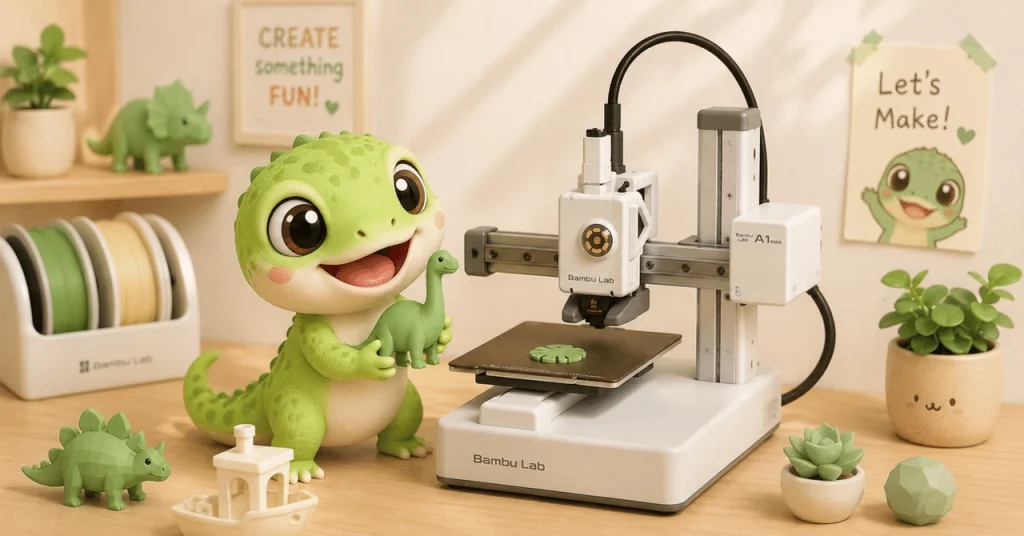
We use a Bambu Lab A1 mini, designing in Autodesk Fusion and preparing prints in Bambu Studio. Making something involves more than pressing a button. You have to imagine how a design will work as a physical object, prepare it for printing, and then wait—sometimes for a long time—to see whether it succeeds.
When a print fails, the disappointment is hard to avoid. The preparation and waiting have already taken time, and the printer has used filament, the material that becomes the finished object. Starting again means spending more of both.
It’s possible to learn from a failed attempt, but that doesn’t make failure feel good in the moment. As I’ve come to realize, learning from failure and being comfortable with failure are two different things.
The causes aren’t always obvious, either. When my child’s print didn’t work, they tried changing settings, including the temperature. Adjusting one thing doesn’t guarantee success: the outcome can depend on several factors, including the settings and the shape being printed. I don’t remember exactly what happened after that particular change, so I can’t say it solved the problem. What stayed with me was my child’s willingness to test a different approach, reconsider, and try again.
That willingness has been one of the most meaningful changes for me as a parent. I’ve helped teach my child how to use Fusion, and they still need support with some of the software. But when a print goes wrong, they’ve begun thinking about what to change next rather than treating the failed attempt as the end.
Sometimes, they even come up with an improvement before we do: “Wouldn’t it be better to do it this way?” They may not always have the right answer, but they’re learning to look at a problem and think through possible solutions for themselves. The value of making something, I’ve found, isn’t limited to the finished object. It includes the time spent asking how it might work, what to change, and what to try next.
My child also enjoys watching a print take shape. A design on a screen gradually becomes a physical object, layer by layer. Until the process is finished, there’s always some uncertainty: Will it look the way we imagined? Will it work? That anticipation is part of the experience, and it makes a successful print especially satisfying.
A 3D printer isn’t simply a convenient appliance that makes anything at the press of a button. You have to design the object, prepare the print, wait for it, and sometimes start over. But that effort is also why we continue using it. My child can turn their own ideas into real objects, then think through what to do when things don’t go according to plan.
Success is joyful, and failure can be painful. It uses up time and material, and there’s no guarantee that every attempt will teach an obvious lesson. Still, working with an idea, testing it, and trying again offers an experience that you don’t get just by receiving a finished product.
The value of a 3D printer isn’t that it prevents failure. It’s that it lets us give shape to our ideas—and think through what to do when the result isn’t what we hoped for.
That’s why, even when a print fails, we want to keep making things together, one attempt at a time.