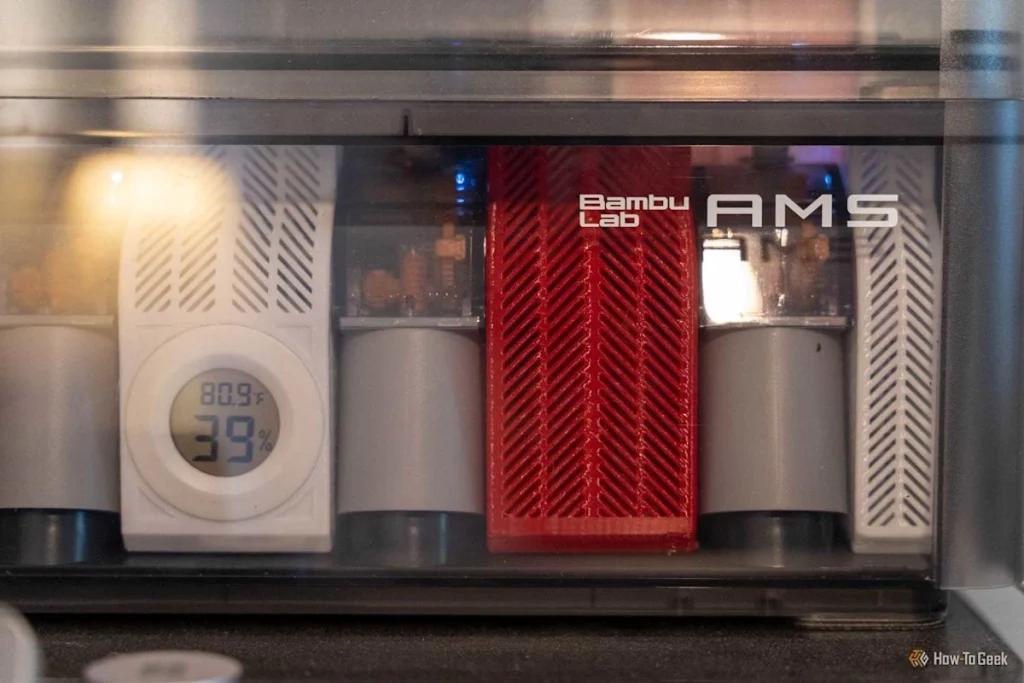
A $2 hygrometer has become one of the most useful upgrades in my 3D-printing setup. It gives me a quick way to check humidity inside my filament storage and decide whether the desiccant needs refreshing or a spool should be dried before a print.
Moisture can cause filament to string, produce rough surfaces, or create weaker parts. A small sensor costs far less than a spool of filament—and far less than the time and material wasted on a failed, lengthy print.
My original Bambu Lab AMS indicates whether conditions are dry or wet with an A-to-E rating, but it doesn’t display a humidity percentage. The rating combines factors such as water content, temperature and relative humidity, and its exact calculation isn’t clearly defined. A standalone hygrometer provides a percentage without requiring an expensive upgrade to a newer AMS.
There’s an important limitation: the sensor measures the air in the box, not moisture inside the filament itself. A low reading doesn’t prove a spool is dry, while consistently high humidity can indicate that moisture-sensitive filament may have absorbed water. If a print matters, drying the filament is a sensible precaution.
The sensor can also be moved to other places, including dry-storage areas. It’s a simple, inexpensive way to monitor conditions and help avoid ruined prints.