SCHOFIELD BARRACKS, Hawaii — The Defense Department is showcasing its largest-ever integration of advanced 3D printing technology with autonomous drones during the Rim of the Pacific (RIMPAC) exercise this summer in Hawaii. This significant event involves the deployment of essential replacement parts and logistics innovations amidst challenging conditions, including 12-foot waves.
Rear Adm. Michael Mattis, Director of Fleet Integration and Innovation for the Pacific Fleet, announced the unprecedented scale of the operation, stating, “This is the largest advanced manufacturing event across the Department of War ever held.” At the Joint Advanced Manufacturing Center, media were shown how this integration enhances logistics by enabling rapid repair requests and the design, construction, and delivery of components in real-time.
The collaboration is described as “Uber for manufacturing, delivered at the speed of Amazon.” This year’s RIMPAC features participation from 38 countries, 31 surface vessels, five submarines, and nearly 180 aircraft, which necessitates robust logistical support to sustain joint forces.
Among the key participants, Firestorm Labs has deployed its containerized xCell 3D printing platform aboard the USS Essex, successfully producing over a thousand parts, even in rough seas. Additionally, for the first time, a 3D printing platform capable of creating metal components is operating aboard the USS Theodore Roosevelt, enhancing the capabilities of U.S. naval forces.
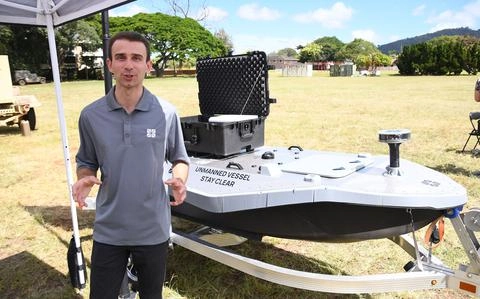
Innovative drone technology is also at the forefront, with Splash Industries’ Typhoon drone making history by autonomously delivering components to the USS Essex. This drone successfully navigated considerable distances in adverse conditions, marking a significant milestone in logistics.
Overall, the integration of advanced manufacturing and autonomous delivery systems at RIMPAC illustrates a transformative shift in military logistics, improving operational efficiency and responsiveness in complex maritime environments.