When a critical component fails on a ship far from shore, crew members face challenges that can lead to costly delays. The ability to manufacture replacement parts directly on board is a game-changer for maritime operations. Additive manufacturing (AM), while transformative in aerospace and healthcare, has yet to fully penetrate the maritime industry due to the unique challenges presented by shipbuilding and harsh sea conditions. However, recent advancements by a consortium led by HD Hyundai Heavy Industries (HHI), which includes the American Bureau of Shipping (ABS) and others, mark a significant development for 3D printing in this sector.
The State of Maritime 3D Printing
In the past decade, maritime 3D printing has evolved, albeit more slowly than in other domains. One notable player, Wilhelmsen, has implemented 3D printing capabilities at its AM center in Singapore, enabling the rapid delivery of spare parts to vessels at sea. They showcased their delivery of components via a drone to a ship, highlighting the potential for on-demand manufacturing.
The partnership between Wilhelmsen and thyssenkrupp led to the establishment of Pelagus 3D, a focused initiative to create a library of 3D-printable parts for marine applications. Organizations such as ABS have also been active in researching AM, creating standards that validate both critical and non-critical 3D printed parts.
“AM has been steadily advancing over the past decade, with progress accelerating in recent years,” noted Dr. Gu Hai of ABS. Standards and support from classification societies aim to integrate such technologies into maritime operations as the industry emphasizes digitization and supply chain resilience.
The U.S. Navy has also been proactive, with a focus on 3D printing technologies, even incorporating a metal printer aboard the USS Essex, the world’s first military vessel to do so.
HHI’s 3D Printing Digital Workshop: A Game-Changer
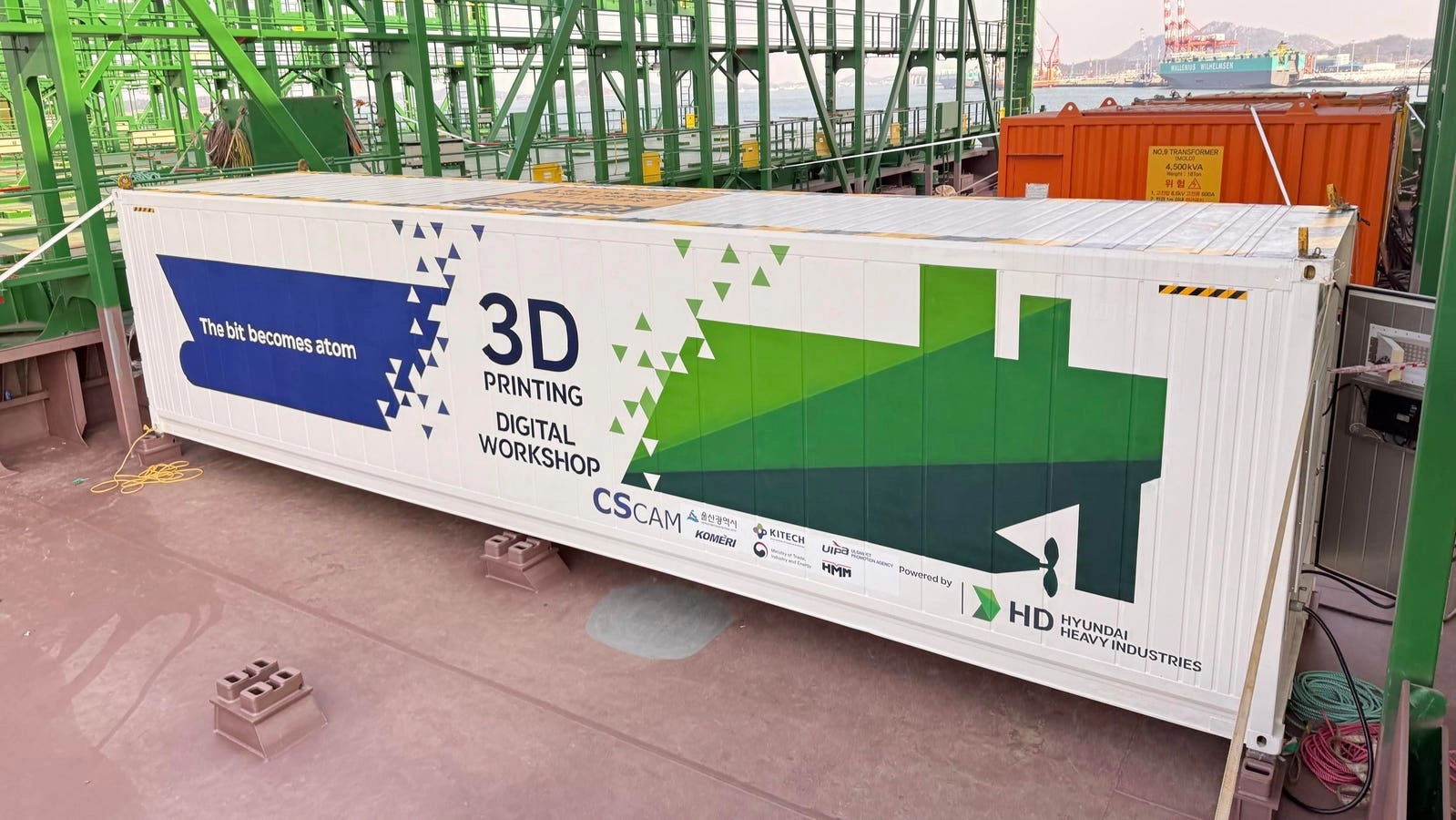
HHI’s groundbreaking 3D Printing Digital Workshop represents a pivotal advance. Developed as part of a collaborative initiative supported by the Korean government, this state-of-the-art mobile 3D printing facility is designed to operate on vessels while counteracting the disruptive effects of sea conditions.
The workshop is fully equipped—from powder management to printing and post-processing—encased in a container that can be deployed easily on ships. Crucially, it features a motion compensation system that stabilizes printing despite vessel movement.
“The most important technology in the 3D Printing Digital Workshop is the application of motion compensation,” explained Mr. Hongryeul Ryu, CTO at HHI. “Our focus is to maintain the same print quality as on land.”
A recent sea trial demonstrated the system’s reliability, successfully printing parts onboard despite challenging conditions.
Advantages and Implications for the Maritime Industry
The primary advantage of the 3D printing capability is a dramatic reduction in lead times for urgent spare parts. Traditional delays for replacements can last an average of 233 days, but onboard printing could streamline the process to as little as two days, significantly minimizing downtime and related logistics costs.
Moreover, HHI has developed new metal powders specifically intended for shipbuilding, optimizing material costs. This custom carbon-steel powder is more economical than those currently in use, paving the way for broader adoption within the industry.
Future Expansion: A Maritime Digital Supply Chain
HHI envisions a future where onboard 3D printing integrates into a global digital supply chain for maritime maintenance. This would permit ships to print necessary components at nearby ports or onboard, thereby reducing reliance on traditional supply chains.
The goal is to enable a network between ports and vessels, where essential components can be easily accessed and printed as needed. “Our vision is to establish digital libraries of vital parts that can be ordered and produced in proximity to vessels,” stated Chulho Jang, a senior engineer at HHI.
ABS Leading the Way for Qualification of Maritime 3D Printing
Classification societies like ABS are crucial to supporting advancements such as HHI’s 3D printing initiative. Through the New Technology Qualification framework, ABS aims to ensure that new technologies are verified and perform as required.
By collaborating with industry leaders, ABS is working to refine qualification processes, making the integration of 3D printing technologies more efficient and supporting their adoption in maritime applications.
Smooth Sailing for Maritime 3D Printing
The traditionally slow adoption of technology in the maritime sector now faces a potential shift with HHI’s initiative. “There is enormous potential for AM in shipbuilding,” stated Dr. Wu Wenjin from ABS, emphasizing the importance of collaboration to accelerate the integration of 3D printing within maritime operations.
The success of this initiative could herald a new era for shipbuilding and maintenance, characterized by reduced lead times, innovative materials, and an interconnected network of operational efficiencies.