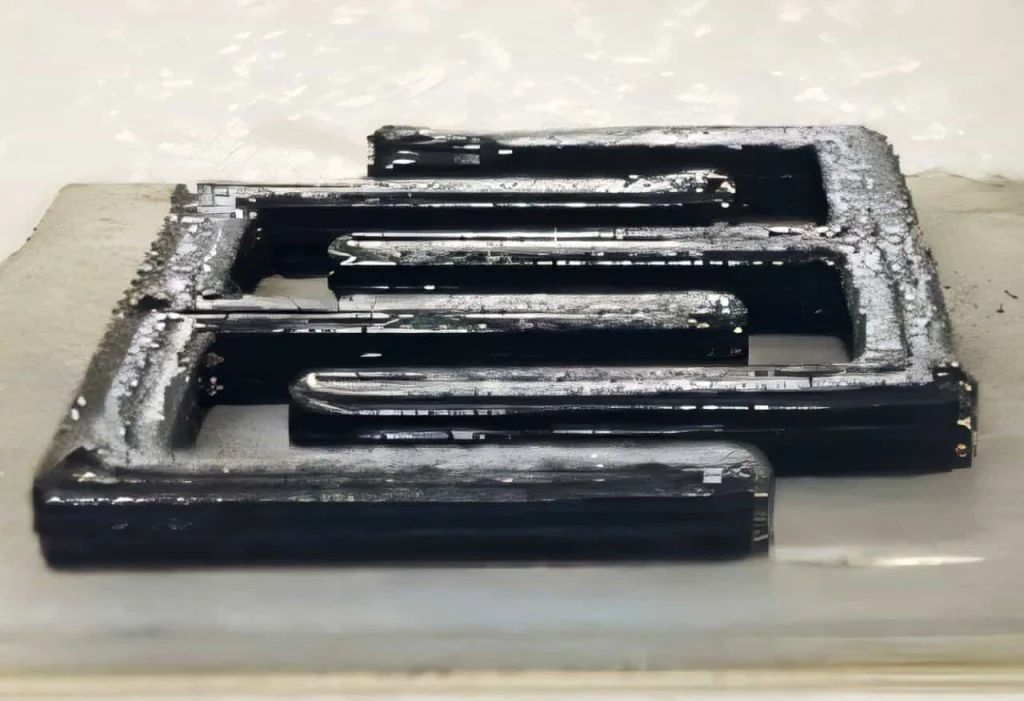
Researchers in China have developed a novel type of concrete that not only supports buildings but can also store electricity. Utilizing a 3D printing technique, they successfully integrated a supercapacitor into a cement-based structure while maintaining the material’s load-bearing capacity. In initial tests, three connected devices produced enough power to light up LEDs, showcasing the potential for walls, floors, and foundations to contribute to the energy needs of the buildings they support.
This groundbreaking innovation comes from the Harbin Institute of Technology and the Chinese Academy of Sciences, with details outlined in a recent study published in ACS Nano. The researchers improved on the efficiency of the energy storage components by arranging them strategically within the cement.
Supercapacitors differ from batteries in certain aspects. While they can store less energy, they charge and discharge much faster, making them well-suited for capturing energy from renewable sources, such as solar panels, and delivering it when necessary. The lead researcher, Jing Zhong, mentioned that consistent charging could enable supercapacitors to meet certain energy demands effectively.
To create the conductive ink for printing, the team used a mix of cement with carbon black and carbon nanotubes. They printed this mixture onto a concrete slab in a unique overlapping pattern that enhances the movement of electrically charged ions. This design minimizes the distance ions must travel and increases interaction between the electrodes and the electrolyte, leveraging the porous nature of the cement.
The prototype achieved an areal capacitance of 162.14 millifarads per square centimeter, alongside a robust energy density of 22.52 microwatt-hours per square centimeter. Importantly, it demonstrated impressive strength, bearing a compression of 23 megapascals—comparable to that of conventional concrete used in construction.
However, the journey from a laboratory proof-of-concept to practical application in real-world buildings is fraught with challenges. Current obstacles include durability, wiring, moisture control, and maintenance needs, especially in colder conditions where performance may decline.
Furthermore, while the idea of buildings acting as energy storage units is gaining traction, supercapacitors still lag behind lithium-ion batteries regarding energy density. The potential lies in integrating these innovations into building materials, with possibilities for applications ranging from emergency lighting to sensors and even local solar energy storage.
Researchers foresee a future where building materials not only serve structural purposes but also contribute to energy management and environmental sensing, transforming our understanding of smart architecture.