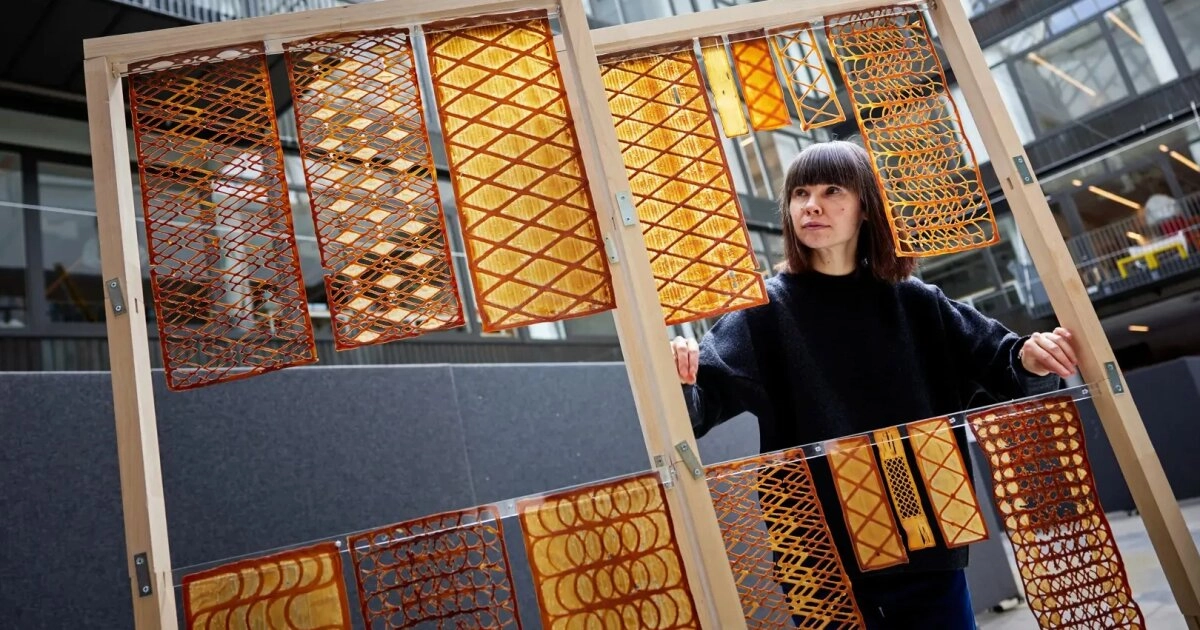
A research team at Chalmers University of Technology in Sweden has developed a novel bio-derived architectural material made from yeast. This innovative substance can be utilized with 3D-printing technology for creating construction materials tailored specifically to the architectural and interior design sectors.
Typically, conventional building materials like plaster, plastics, and synthetic fabrics are derived from non-renewable sources, often contributing significantly to global emissions and resource depletion. In contrast, the new yeast-based material is designed to be biodegradable, sustainable, and a zero-waste option.
Prof. Malgorzata Zboinska, the study’s leader, emphasized her interest in merging architecture with living materials, highlighting that the research aims to craft a renewable architectural material entirely from organic ingredients. The integration of biomaterials with digital manufacturing offers a unique perspective on the design and production of architectural components.
In this process, the yeast is deactivated through heating before it is mixed into the material, serving as a binder without undergoing fermentation. Zboinska noted that yeast has a robust growth capability, making it less sensitive to contamination and allowing for the production of a more consistent material.
The formulated mixture also incorporates cellulose wood fibers for added strength, alginate from brown seaweed for stability during 3D printing, plant glycerols for flexibility, and water. When these components are blended with the yeast, they yield a gummy hydrogel that can be shaped as needed.
Yagmur Bektas, a doctoral student and co-author of the study, commented on the advantages of 3D printing, pointing out that it enables the creation of intricate forms without generating waste. The resulting jelly-like mixture is then extruded through a printer and air-dried to achieve its final form at room temperature, minimizing energy consumption.
With slight modifications to the material’s formula, a variety of colors from yellow to brown can be achieved, along with options for transparency and textures by incorporating natural pigments or colorful yeast strains. However, further research is critical before this material can be used extensively in construction, particularly to evaluate its strength, fire safety, and moisture tolerance, as well as to explore scalable production methods.
Prof. Zboinska remarked on the exciting future of Engineered Living Materials (ELMs), indicating the potential for creating customizable materials that could possess self-healing properties or functionalities such as air purification. The progress made thus far represents a significant initial step toward a new kind of architectural material, laying the groundwork for future innovations that prioritize sustainability, functionality, and design.
Source: Chalmers University