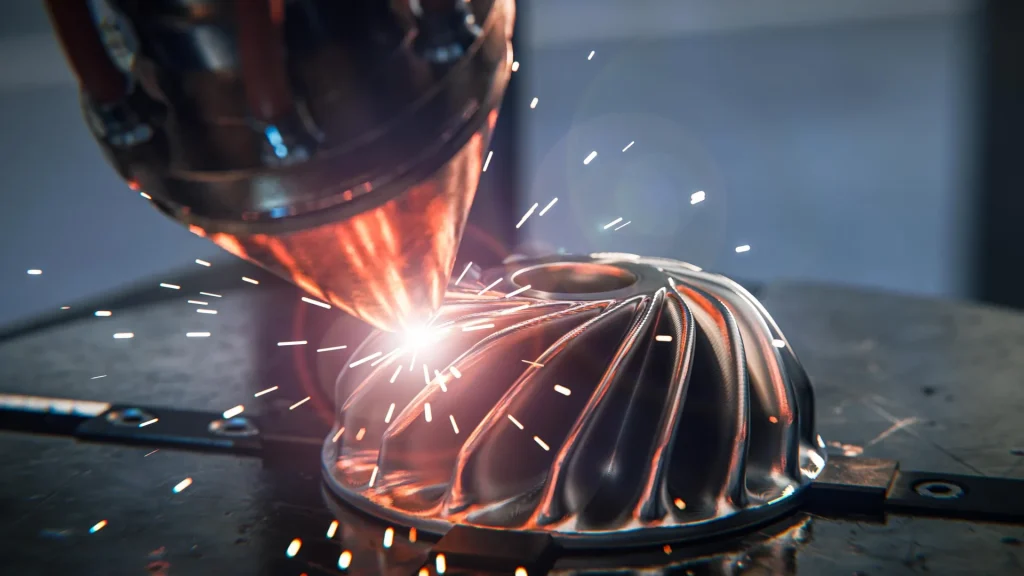
Researchers at Hiroshima University have made a significant breakthrough by 3D printing tungsten carbide-cobalt (WC-Co), one of the hardest metals on Earth, using a novel additive manufacturing technique. This new method addresses both the challenges of high material costs and waste associated with traditional manufacturing processes.
Tungsten carbide-cobalt is prized for its durability and resistance to wear, making it ideal for cutting tools and other industrial applications. The conventional production method, powder metallurgy, involves compressing fine powders of tungsten carbide and cobalt under high pressure and heating them in sintering machines. This process can be wasteful, often resulting in more raw materials being consumed than are utilized in the final product.
The research team’s approach uses a hot-wire laser irradiation method that combines a laser beam with preheated filler wire. This technique allows for more efficient material deposition—softening rather than fully melting the components, which helps to preserve their hardness and mechanical integrity.
Two configurations of this technique were tested. The first involved directing the laser onto the top of a pre-placed carbide rod, while the second used the laser to irradiate the area between the rod and the base material. Both approaches successfully produced defect-free samples with hardness exceeding 1400 Vickers hardness (HV), placing them among the top materials used in industry for toughness.
While the laser-leading method showed promise, it faced challenges in maintaining the required hardness. To address this, researchers introduced a nickel alloy-based middle layer and meticulously controlled the temperatures during the process. These modifications allowed for successful production without sacrificing the material properties.
This innovative method not only reduces material costs and waste but could also lead to more complex shapes and applications in the manufacturing of cutting tools. Researchers aim to refine the technique for larger scale production while continuing to explore how to enhance durability and further minimize waste.
The findings were published in the International Journal of Refractory Metals and Hard Materials.
For further details, refer to the original study: Effect of the hot-wire laser irradiation method and a Ni-based alloy middle layer on mechanical properties and microstructure in additive manufacturing of WC–Co cemented carbide.