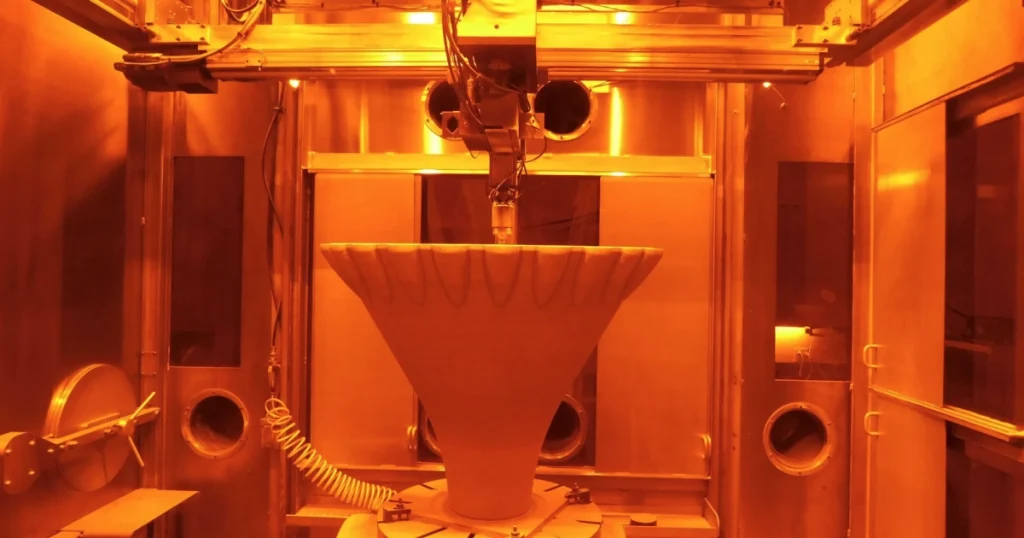
High-entropy alloys (HEAs) are innovative materials that combine multiple elements to create unique properties, but they are notoriously difficult to produce due to the challenge of achieving proper atomic-level mixing. Researchers at the US National Institute of Standards and Technology (NIST) have introduced a new 3D-printing technique that enhances the creation of these alloys by employing a novel "laser stirring" approach.
Traditionally, alloys are made by blending one dominant metal with smaller amounts of other elements. For example, adding carbon to molten iron creates steel, known for its strength, while nickel and chromium yield stainless steel. However, aerospace and energy sectors increasingly demand materials that outperform these conventional options, leading to the exploration of HEAs, which typically consist of five or more metals in similar ratios.
The primary hurdle is that different metals don’t mix well due to differences in density and melting points, often resulting in uneven mixtures that can weaken the material. NIST’s new technique addresses this by altering the laser path during 3D printing from straight lines to elliptical loops, which stirs the molten alloy and promotes blending.
Most existing methods, such as arc melting, are insufficient for producing complex parts needed in advanced engineering applications, often limited to simpler shapes. NIST researchers harness the capabilities of metal 3D printing, which uses lasers to melt selected areas of metal powder layer by layer, enabling intricate designs. However, for HEAs, the conventional method lacked the necessary time and movement for effective mixing.
By programming the laser to create loop patterns, the team allowed the molten metals to mix right before solidification—effectively "stirring" the melt pool. This method also avoided extensive hardware modifications, though the team developed new software to produce the intricate toolpaths needed.
To validate their process, the researchers experimented with a dense refractory alloy and a lightweight titanium alloy, which typically do not mix well. Using X-ray diffraction at the Advanced Photon Source, they were able to observe atomic changes in real-time as the metals melted and cooled. The results indicated that laser stirring effectively improved mixing and demonstrated that the laser’s path can be a critical factor in alloy formation during 3D printing.
Looking forward, the implications of this innovation are significant. Current metal 3D printing often relies on pre-alloyed powders, but NIST’s approach hints at a future where printers could blend simpler metal powders analogous to how color printers mix inks. This capability could lower production costs and enhance versatility, allowing for gradual variations in alloy composition within a single part.
Despite these advancements, challenges remain. The current research is not yet an industrial standard; factors such as processing conditions, cracking, and heat treatment still need to be addressed. Further developments are essential to refine these methods for commercial applications.
Source: NIST