3D printing often involves trade-offs: extrusion methods can use a broad range of materials but tend to be slow, while light-based printers are fast and precise but generally require thin, light-sensitive resins.
Researchers at Northwestern University have developed a method called direct ink additive lithography (DIAL) that aims to combine the strengths of both. It uses patterned light to cure thick, functional inks, enabling fast, detailed printing without relying on a nozzle to draw every feature.
The process begins when a slot-die nozzle lays down a paste-like ink. A blade spreads it into a layer about 50 micrometers thick, then a projector shines a pattern onto the material. Light hardens the selected areas through photopolymerization, forming one cross-section of the object at a time. The printer repeats the process layer by layer, and the uncured ink is washed away at the end.
Unlike conventional extrusion printing, DIAL cures an entire projected pattern at once. The level of detail depends mainly on the projector’s pixel size and the thickness of each layer, rather than on the nozzle’s diameter.
The ink also serves as temporary support for the structure. Researchers added fumed silica nanoparticles to give it yield stress: it flows under the blade’s pressure, then firms up once the blade passes. This lets uncured ink hold delicate features in place as printing continues. Afterward, the excess can be removed, and material left on the printing surface can be collected and reused.
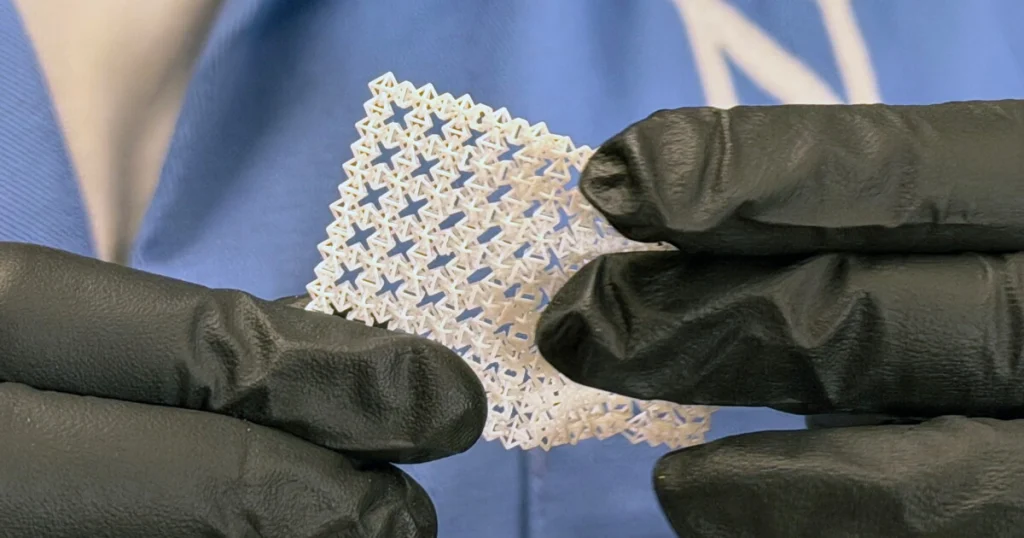
In tests, DIAL printed a porous grid in 30 minutes, compared with 124 minutes using conventional extrusion printing. It also produced lattice walls as thin as 150 micrometers, as well as complex, interlocking shapes such as chainmail. The team demonstrated printing multiple objects at once and building structures from different materials in successive layers.
The researchers also tested inks designed for specific functions. A polymerizable ionic-liquid ink was used to print 15 porous electrolyte lattices, each about the size of a coin-cell battery, in a single 15-minute run. Another formulation, a hydrogel, produced miniature containers modeled on cell-culture inserts used in biomedical research.
DIAL brings together techniques that already exist—extrusion, projector-based curing and yield-stress materials—in a single manufacturing process. The combination could eventually be useful for making items such as flexible robotic components, medical devices, lightweight aerospace structures, batteries and engineered tissue environments.
For now, the method remains at the laboratory stage. Its performance with a wider range of materials, at larger scales and in industrial applications still needs to be established. The team is continuing to develop the inks, hardware and software needed to expand the process.
The research was published in Science Advances. Further details are available from Northwestern University.