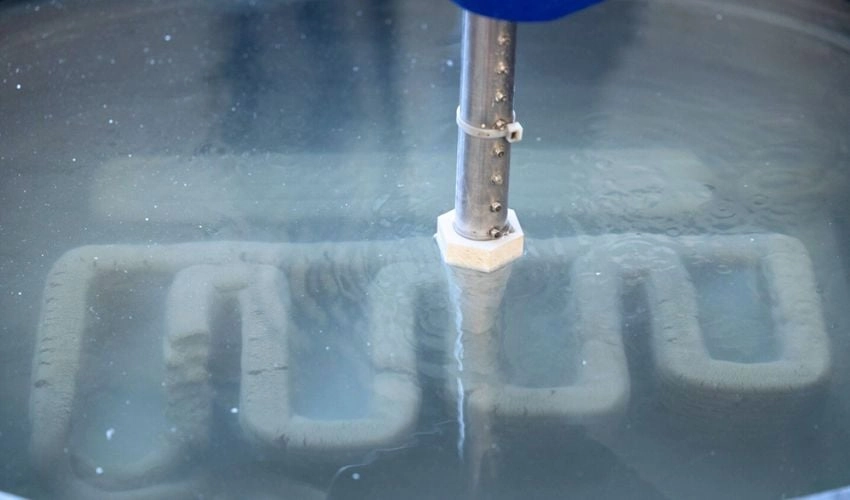
The construction of underwater structures presents significant challenges due to the difficult conditions of depth, pressure, and limited visibility. Researchers at Cornell University are pioneering a project that could change how we approach this type of construction by utilizing 3D printing technology directly on the seafloor. This method, referred to as in situ construction, aims to enable the fabrication of maritime infrastructure where it is needed, without the complications associated with prefabrication and surface deployment.
Led by Sriramya Nair, an assistant professor of civil and environmental engineering, the project is funded by the Defense Advanced Research Projects Agency (DARPA), which has set the ambitious goal of developing a concrete capable of being printed under several meters of water. The team is competing in a challenge where they must demonstrate their ability to 3D print a concrete arch underwater. They received a $1.4 million grant, which is contingent upon meeting technical benchmarks throughout the project.
One of the key innovations of this project is the requirement to use seafloor sediment as the primary material for the concrete, reducing the need for large cement transport by ship. This presents both opportunities and challenges, as no one has successfully 3D printed structural concrete with seafloor sediment before. Nair notes, “Nobody takes seafloor sediment and prints with it. This is opening up a lot of opportunities for reimagining what concrete could look like.”
There are significant obstacles to overcome, including the issue of washout, which occurs when cement particles dissipate in water before they can bind, thereby weakening the structure. While chemical admixtures could help mitigate this issue, they can also increase the viscosity of the material, complicating the pumping and extrusion processes. The team is conducting experiments in controlled environments to refine the balance of these materials, but they face unique challenges when transitioning to real-world underwater conditions.
To enable effective construction operations in murky underwater environments, the researchers are also developing sensor-based systems and robotic controls for real-time adjustments during the 3D printing process. As sediment is disturbed, visibility can drop to near zero, making automation crucial for successful deployment.
The advancements suggested by this project could pave the way for a smarter approach to underwater construction, reducing logistical complexities and minimizing environmental disruption while providing a novel perspective on large-scale 3D printing in one of the Earth’s most challenging environments.
For more insights into advancements in 3D printing, especially related to the aerospace and defense sectors, consider checking out our dedicated content.