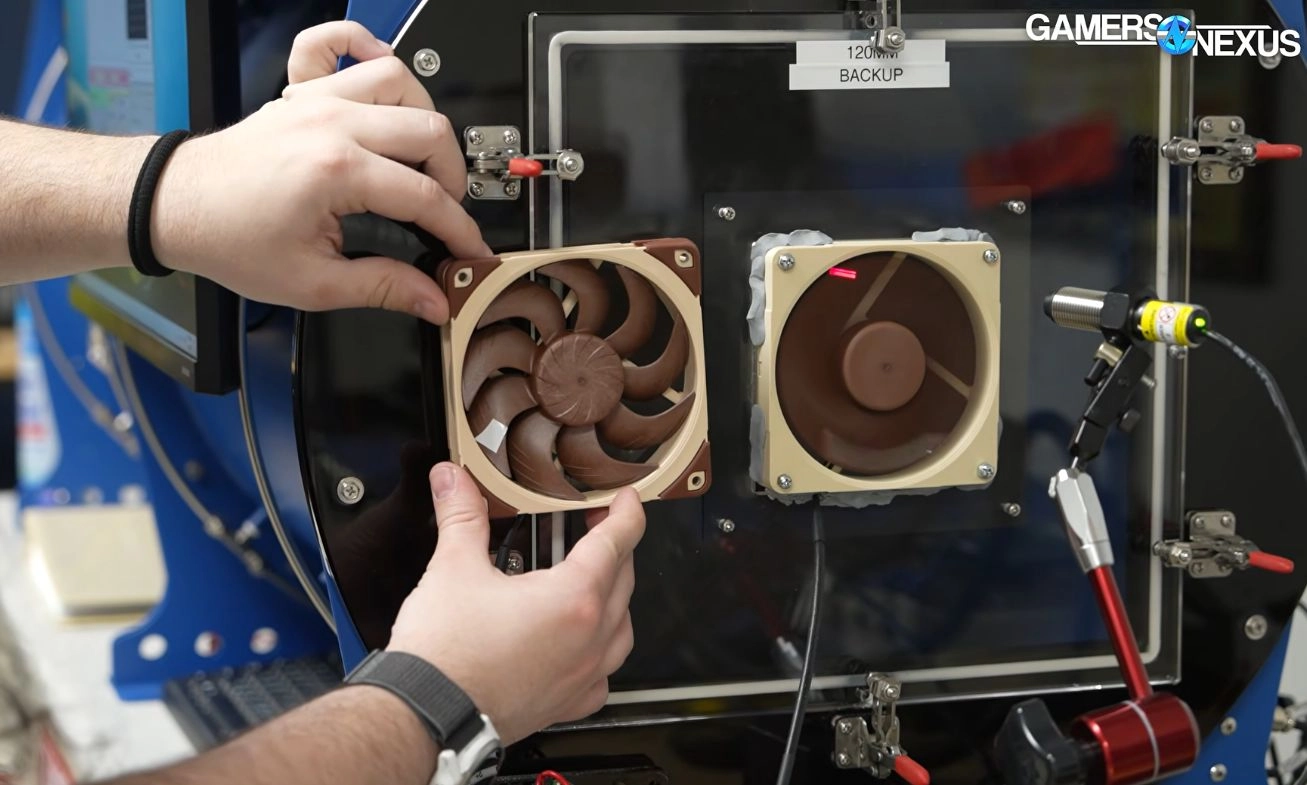
After Noctua released CAD files for their computer fans, many wondered if they could simply 3D print these fans. Despite Noctua’s concerns and the slight design modifications made to the files to discourage unauthorized reproductions, the question remained. Fortunately, Steve from Gamers Nexus conducted an investigation on the practicality of 3D printing a computer fan.
The findings were largely unfavorable. Even after adapting the original CAD models to be compatible with a Bambu Lab FDM printer and printing the components using PLA, the most critical part—the motor—had to be obtained from an original Noctua fan. Although a cheaper motor could be acquired, it could adversely affect fan performance.
Material limitations also posed significant challenges. Noctua’s unique polymer is engineered to maintain its shape under operational stress, whereas PLA and most other thermoplastics are susceptible to deformation during use, risking blade contact with the fan’s inner structure. Consequently, in the PLA version, a 3 mm gap was implemented compared to the 0.5 mm gap characteristic of the original fan.
Using Gamers Nexus’ professional fan testing equipment in a semi-anechoic chamber, they compared the performance of the original fan against the 3D-printed replica. The 3D-printed fan exhibited similar noise levels but only achieved about half of the airflow of the original. This discrepancy is attributed to variations in blade shape and angle, the larger gap, and various other factors that warrant the investment in the authentic Noctua fan.
Ultimately, these CAD models might be better utilized for fit testing in larger designs rather than for creating a functional fan. So, while 3D printing these fans might fulfill specific design needs, it isn’t a suitable alternative for reliable cooling performance.