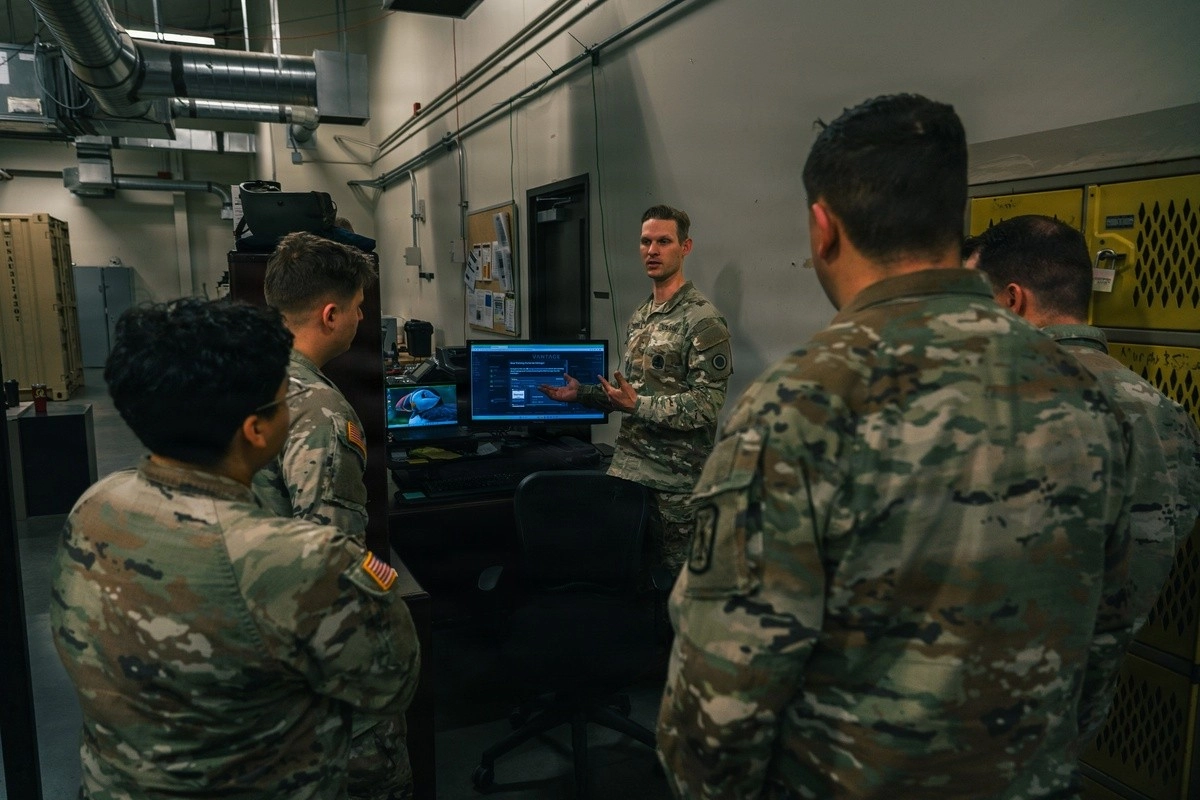
JOINT BASE LEWIS-McCHORD, Wash. — Recently, the 1st Special Forces Group (Airborne) hosted a 3D printing symposium aimed at enhancing the skills and knowledge of Soldiers regarding additive manufacturing. This initiative provided hands-on experience, demonstrating how 3D printing can address battlefield challenges and support operational readiness.
Sgt. Clarissa De La Cruz, an allied trade specialist, emphasized the significance of 3D printing in her role. She explained how this technology enables her to fabricate, repair, and modify equipment efficiently. “The Army is starting to be more innovative… to see how much we can really fully sustain ourselves,” she remarked, noting the advantages of 3D printing in creating necessary parts.
During the symposium, participants learned the entire process of additive manufacturing, from computer-aided design (CAD) to printing. Using software like SolidWorks and PrusaSlicer, Soldiers experimented with different print settings that influence the durability and flexibility of the components produced. De La Cruz explained that various materials serve specific purposes, ranging from basic plastics to robust filaments suitable for demanding applications.
The goal of the event was to familiarize Soldiers with 3D printing so they can identify potential solutions within their units. While not intended to make every participant a specialist, the symposium showcased the technology’s potential.
De La Cruz noted that 3D printing is already utilized in their operations to create a variety of useful items, such as radio caps, training aids, and even decoys. The speed of production offers a significant advantage for units, allowing for quick replacements of parts that would typically take longer to arrive through traditional supply chains. For example, a vehicle door handle could be printed in as little as an hour, facilitating faster repairs.
Moreover, the symposium introduced the concept of recycling plastic into usable filaments, with De La Cruz mentioning the Recreator 3D system. This innovative process repurposes plastic bottles into materials for printing, supporting sustainability and reducing waste in operational environments.
As the Army looks toward more advanced applications, the potential for innovations such as wire arc additive manufacturing (WAAM) is on the horizon. This method could enable the production of metal components through 3D printing.
Despite the challenges that accompany technological advancement—such as software costs and training requirements—the symposium provided valuable insights into modernizing military practices. De La Cruz expressed enthusiasm for the capabilities of 3D printing, underscoring the endless possibilities it presents for Soldiers eager to develop their skills.
The symposium reaffirmed that innovation often starts with identifying a problem and creatively designing a solution: a layer-by-layer approach that embodies the spirit of advancement within the Army.