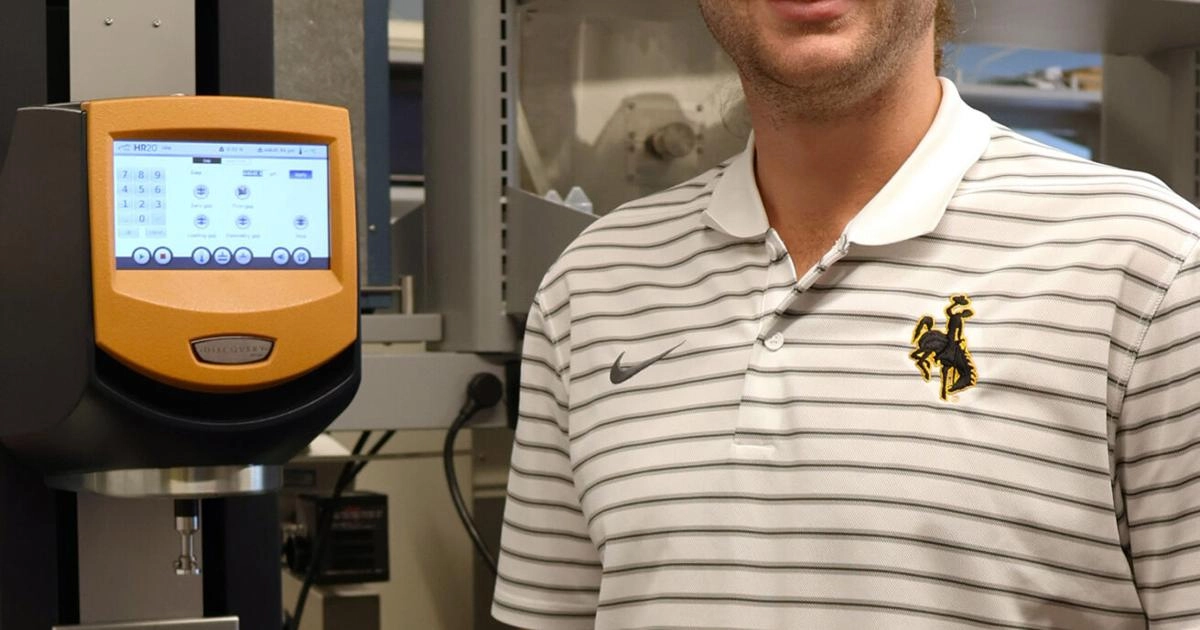
Daniel Rau, an assistant professor in the University of Wyoming’s Department of Mechanical Engineering, has received a significant grant from the National Science Foundation to explore advancements in 3D printing, specifically targeting soft materials. Despite rapid growth in 3D printing technology, current capabilities largely focus on producing hard plastic products. Rau aims to address this limitation through his research at the university’s Additive Manufacturing Lab (RAM Lab).
With a grant totaling $198,932, Rau intends to study the shortcomings of additive manufacturing processes when it comes to printing elastomers—materials that are flexible and rubber-like. His project, titled “Improving the Vat Photopolymerization 3D-Printing of Soft Elastomers Through a Deeper Understanding of Process Dynamics,” will investigate why current methods often result in warped, unusable products instead of stable, functional items.
Rau joined the UW faculty in fall 2024, and reflected on the essential role of NSF’s support in helping emerging professionals initiate their research careers. The grant is designed to facilitate the research initiatives of new faculty members, enabling them to cover research expenses and provide student stipends.
Rau’s work specifically involves photopolymers, which change from liquid to solid when exposed to UV light. Despite their potential, there are still many unanswered questions about the curing process that need to be addressed to optimize production. To advance his research, he plans to utilize two innovative techniques: photorheology and X-ray photon correlation spectroscopy, examining the adhesion processes at a microscopic level.
This research has the potential to revolutionize the production of soft materials used in various applications, particularly in the biomedical field. For instance, soft implants, wearable devices, comfortable athletic footwear, and improved protective gear like football helmets could all benefit from advancements in 3D printing developed from Rau’s findings.
Rau envisions that the insights gained from his study could lead to a comprehensive guide for tailoring 3D manufacturing processes for soft materials, aligning with the human body’s natural softness and improving comfort and safety in numerous everyday products.