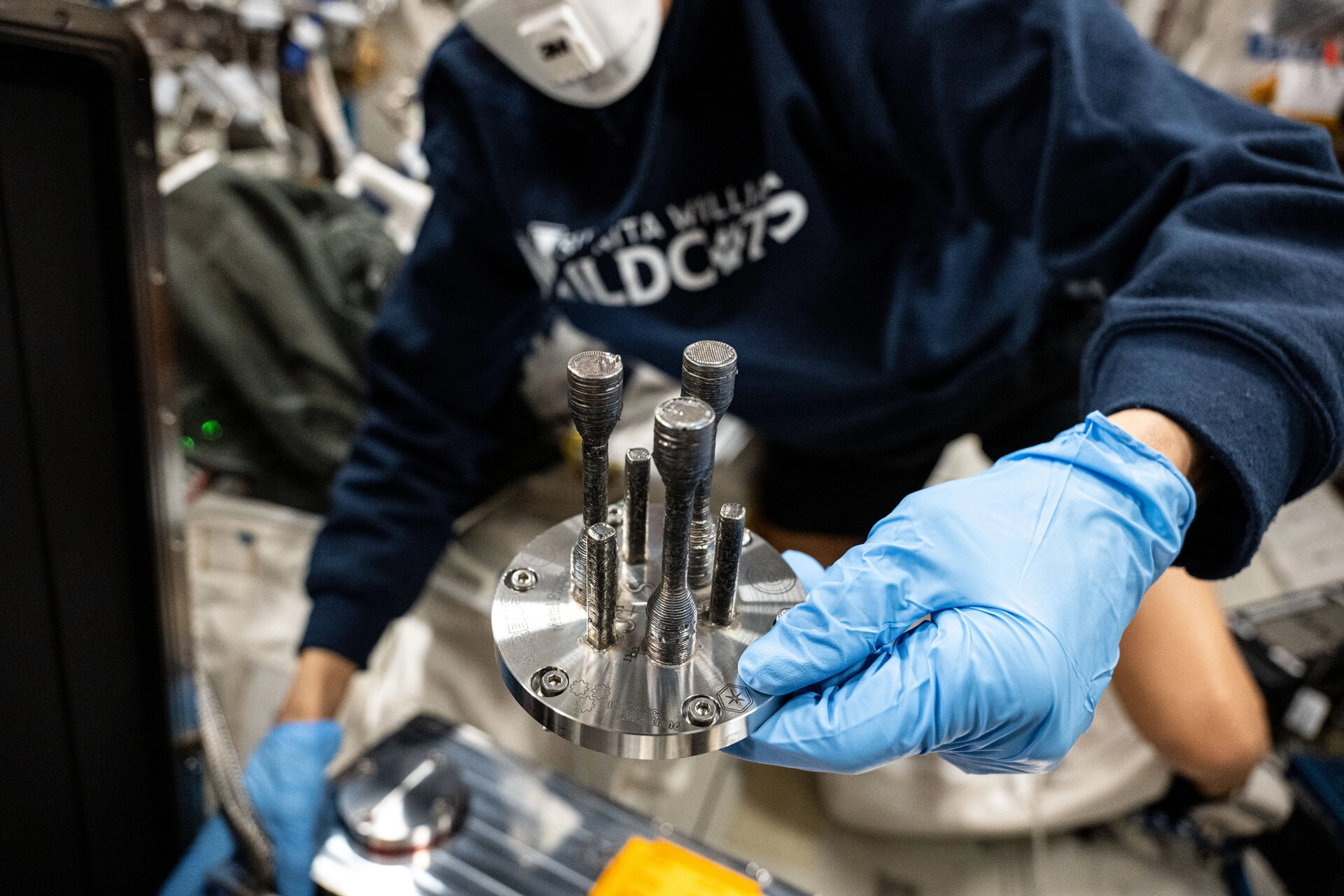
The European Space Agency has announced a groundbreaking achievement: the first 3D printed component created in the realm of space. This milestone is set to have significant implications for the commercial space sector.
ESA’s metal 3D printer has successfully manufactured the first metal part ever produced beyond our planet.
If someone were to claim that 3D printing technology, which was predominantly employed for creating plastic models back in the 1980s, could significantly impact the future of humanity, it might seem exaggerated. However, the remarkable growth of this technology, commonly referred to as Additive Manufacturing (AM), is poised to bring about widespread consequences beyond our current understanding.
With rapid developments over recent decades, contemporary 3D printers are capable of producing a diverse array of objects from materials such as plastics, liquids, powders, and even metals. This versatility has facilitated innovative applications across nearly every sector of life, including biomedicine, where the technology is being utilized to ‘print’ replacement organs and living tissues.
In a similar vein, space agencies alongside the commercial space sector are embracing 3D printing to reduce costs and enhance efficiency. When combined with reusable rockets and ride-share spacecraft, this approach is expected to become more economically viable for launching payloads and crews into space. Additionally, AM holds the promise of enabling assembly in orbit, thereby allowing for the replacement of components or even the construction of an entire shuttle in the cosmos.
In pursuit of these goals, the European Space Agency (ESA) has recently presented the first-ever 3D metal printer assembled aboard the International Space Station (ISS), a milestone that could revolutionize the entire space industry. This 3D metal printer was created by an industrial team led by Airbus Defence and Space in collaboration with the ESA’s Directorate of Human and Robotic Exploration.
“The initial technology demonstrator for in-space manufacturing illustrated how to navigate various challenges to create metal components within such a critical environment: from miniaturizing an industrial machine to fit within a space station’s constraints and withstand a space launch, to managing the effects of microgravity, utilizing raw materials sent into orbit as efficiently as possible, reducing the emissions and particles produced during the metal fusion process, ensuring safe operation of a high-power laser on the ISS, and ultimately, operating a manufacturing machine with a high degree of autonomy while being remotely controlled by ground operators,” explained Anthony Lecossais, the lead engineer on the 3D metal printer’s development, discussing the importance of this achievement in an email correspondence with Interesting Engineering.
By moving this essential manufacturing capability to Low Earth Orbit (LEO), businesses and space organizations can reduce expenses by creating replacement components and tools in orbit instead of depending on resupply missions from Earth.
The notion of 3D printing was initially introduced by science fiction writer Murray Leinster in his 1945 short story ‘Things Pass By’. This idea is highlighted in a brief section where the protagonist describes the process and advantages of an innovative machine he has developed. Within the discussion, he outlines how this technology could be utilized to manufacture spacecraft:
“Typically, you design a specialized machine tool to produce one specific part, which will yield that part more economically than any alternative method. However, if you attempt to change the product, the machine becomes obsolete. You gain efficiency, but at the expense of flexibility.”
“Due to this, there are currently no mass-production machines for large items such as ships. It’s more cost-effective to remain inefficient and adaptable. However, this particular constructor manages to be both efficient and adaptable. I input magnetronic plastics — the materials used in the construction of modern houses and ships — into this mobile arm…
“It’s primed to create a spaceship hull at this moment.”
The phrase ‘3D printing’ initially described a specific process patented by researchers at the Massachusetts Institute of Technology in 1993, which was subsequently licensed to multiple manufacturers. In contemporary usage, the term has become synonymous with additive manufacturing, encompassing a variety of related techniques. At the heart of these methods is computer-aided design, whereby engineers craft three-dimensional computer models of objects. These models are then converted into a series of two-dimensional ‘slices’ that the printer can use for deposition.
Currently, the technology’s versatility, accuracy, and consistency have advanced to such an extent that 3D printing is recognized as a feasible method for industrial production. Furthermore, its applications have expanded well beyond plastics. Between the 1980s and early 2000s, researchers explored novel methods and techniques that would eventually lead to 3D metal printing. This includes metal binder jetting, developed by Dr. Ely Sachs at MIT, laser-sintering technology, electron-beam melting (EBM), and Joule Printing.
When compared to conventional manufacturing methods, 3D printing brings a host of benefits. Traditional manufacturing often relies on a ‘top-down’ method, where raw materials are cut, molded, and assembled; in contrast, 3D printing employs a ‘bottom-up’ technique, constructing objects layer by layer (slice by slice). As Leinster noted, these advanced techniques are now at a stage where they are employed in the creation of rocket components and parts intended for space exploration.
The aerospace sector is progressively integrating this technology for nearly all rocket-related applications. For example, NASA has utilized its Reactive Additive Manufacturing for the Fourth Industrial Revolution (RAMFIRE) method to fabricate an aluminum rocket nozzle along with a thrust chamber for a rocket engine. The agency also applied 3D printing to create a prototype of a Rotating Detonation Engine (RDE), which they successfully test-fired last year.
The private space industry has embraced 3D printing to enhance manufacturing processes. One example is the aerospace manufacturer Relativity Space based in California, which utilizes 3D printing, artificial intelligence, and autonomous robotics to construct both the framework and the engines of its rockets.
“Metal 3D printing has completely transformed our approach to designing and producing satellites and launch vehicles, enabling more efficient and complex designs, incorporating additional features into parts (such as cooling systems and sensors), and reducing the total number of components and necessary assembly tasks. Furthermore, 3D printing contributes to a reduction in raw material waste compared to conventional machining, a significant factor when dealing with high-end alloys applicable to the aerospace sector. Overall, 3D metal printing facilitates the creation of intricate components while minimizing setup expenses, making it a financially viable option for low-volume production prevalent in space missions,” explained Lecossais.
The journey towards in-space manufacturing aboard the International Space Station (ISS) commenced in 2014 with NASA’s deployment of a technology demonstrator provided by Made In Space. This groundbreaking 3D printer utilizes fused filament fabrication to produce objects from plastic and showcased the viability of 3D printing in a microgravity environment.
Subsequently, the Additive Manufacturing Facility (AMF) was established on the ISS, leading to the creation of the first 3D-printed tools in space, such as a wrench and a ratchet wrench, among others. In 2019, NASA expanded this initiative by attaching the ReFabricator experiment, developed by Tethers Unlimited, to the ISS. This system demonstrated the ability to produce 3D-printed parts from recycled plastic materials, effectively showing how waste can be repurposed in space for the manufacturing of essential components.
Notably, the European Space Agency’s (ESA) metal 3D printer has made history as the first device to successfully print a metal component under microgravity conditions. This technology demonstrator was sent to the ISS earlier this year and became functional by June. By August, it achieved a remarkable milestone with the creation of the first ever 3D metal shape. Following this success, the ESA plans to produce three additional components to return to Earth for quality evaluation and testing.
Looking ahead, both space agencies and commercial space enterprises are eager to establish operations in Low-Earth Orbit. This includes the construction of satellite internet networks, space-based solar power systems, private space stations, and even space hotels. Likewise, asteroid mining companies are working on developing platforms in cislunar space aimed at facilitating the extraction of resources from Near-Earth Asteroids.
During the period from 2012 to 2022, the space economy experienced significant growth of over 60%, reaching an estimated value of around $400 billion. Projections suggest that the space sector could exceed $3 trillion by the year 2050. This expansion is expected to continue as the costs of launching into space decrease, prompting various agencies and companies to deploy more satellites and space stations in low Earth orbit (LEO). Notable proposals for private space stations currently include Axiom Station developed by Axiom Space, Voyager Space’s Starlab, Blue Origin and Sierra Space Corporation’s Orbital Reef, and Vast Space’s HAVEN-1.
The ability to 3D print components while in space may prove essential for commercial activities in LEO. As this region becomes increasingly populated with engineers, customers, researchers, and workers, there will be a heightened demand for services focused on repairs and replacements. Maintenance and refurbishment of shuttles will be necessary between voyages, and on-orbit equipment will need regular service and repairs.
By providing print-on-demand capabilities in space, agencies and companies could free themselves from the limitations of sourcing parts and tools from Earth. Additionally, this capability would facilitate the on-orbit assembly of spacecraft, foundries, and manufacturing facilities in space.
“In-space manufacturing has the potential to transform operations and logistics associated with space exploration by diminishing the need for expensive and time-consuming launches from Earth, as well as enabling the production of materials and goods that are optimized for the challenges of space. This involves creating maintenance components on-demand and in-situ, eliminating reliance on logistics for storing spare parts, and ultimately bolstering the independence and capacity for prolonged missions on the Moon, Mars, and beyond,” remarked Lecossais.
One of the defining characteristics of the new space era is the reduction in costs that is broadening access to outer space. The overarching aim is to shift industries, manufacturing, and research to Low Earth Orbit (LEO) where microgravity environments can be exploited, ultimately diminishing our ecological footprint on Earth. Furthermore, the establishment of in-orbit infrastructure will support missions to the Moon, Mars, and beyond, enabling humans to sustain operations in space for extended durations. Achieving this will open the door to the possibility of human settlements on Space and other celestial bodies within our Solar System.
Stay informed on engineering, technology, space, and science news with The Blueprint.
By clicking sign up, you confirm that you accept this site’s Terms of Use and Privacy Policy
a day ago
a day ago
a day ago
a day ago