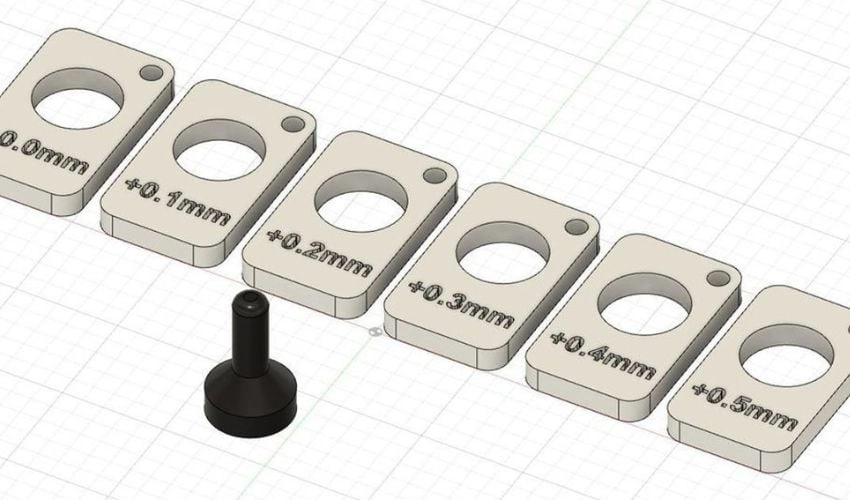
When discussing tolerance in 3D printing, it’s crucial to understand its specific meaning within this context. In additive manufacturing, tolerance refers to the permissible limit of variation in a manufacturing process, which is vital to achieving accurate and precise prints.
To differentiate, accuracy denotes how close a measurement is to its true value, while precision relates to the consistency of repeated measurements. Accurate 3D prints match the CAD design closely, whereas precise prints reproduce identical parts consistently on the same machine. Understanding these concepts is essential for optimizing 3D print quality, as tolerance directly influences both accuracy and precision.
Factors Influencing Tolerance
Tolerance manifests itself in various ways in 3D printing. Typically, during discussions of resolution, tolerances are denoted with a ± sign, indicating the allowable variation in printed dimensions. Different printing technologies have varying tolerances; for instance, fused deposition modeling (FDM) has a tolerance of about ±0.5% per 100mm, while stereolithography (SLA) boasts a smaller tolerance of about ±0.2%. Advanced technologies like PolyJet achieve even finer tolerances ranging from ±0.05 to 0.1 mm.
Printer settings and materials play a significant role in how tolerances are established. Material shrinkage induced by heating leads to variations, with different materials exhibiting distinct shrinkage levels. When temperatures change rapidly, issues like warping can occur, making temperature control crucial, particularly in printers that utilize high-performance materials.
Layer thickness and minimum feature size are also critical in defining resolution and tolerances. These factors can be affected by printer calibration and user error. Moreover, post-processing methods, such as sanding and smoothing, can influence the dimensions of the final part, further contributing to tolerance issues.
Improving Tolerance in 3D Printing
There is no definitive solution to eliminate tolerance issues entirely in 3D printing, but there are methods to mitigate their effects. One effective strategy is to print calibration models. These serve as tests to understand the specific tolerances of a particular printer and material. After printing a calibration model, precise measurements of the part can reveal the actual variances.
Additionally, regular maintenance of 3D printers, which includes cleaning the print bed, tightening screws, and lubricating moving parts, can also enhance tolerance consistency in prints. Ensuring that the printer is leveled and that the extruder is functioning properly contributes to better accuracy and lower tolerances.
By understanding and applying these considerations, users can gain insight into their printer’s tolerances and tailor their designs accordingly. Continuous testing, particularly when precise fits or functional components are necessary, is crucial to achieving the desired results in 3D printing projects.