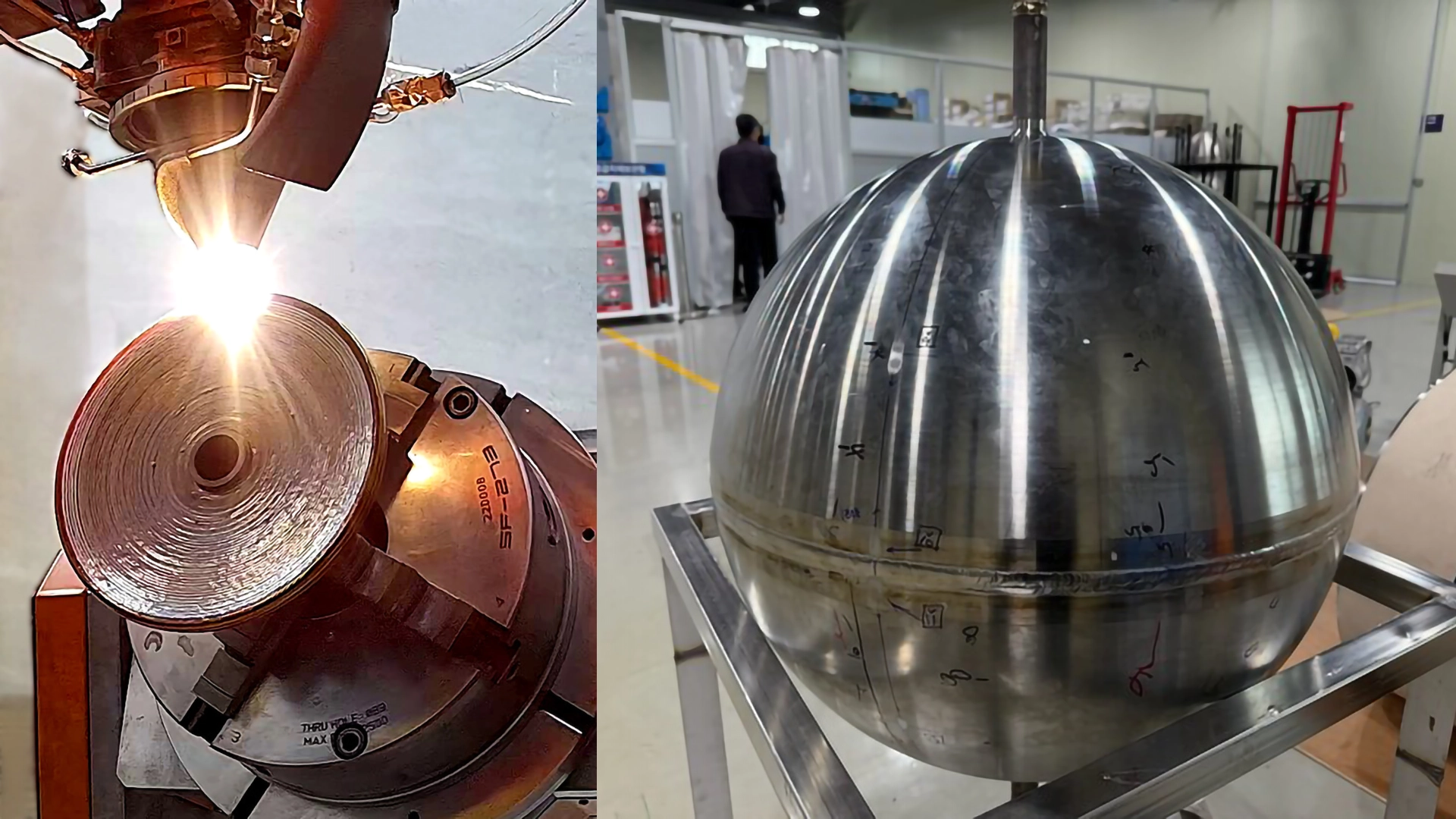
A significant advancement in 3D printing has emerged from the Korea Institute of Industrial Technology (KITECH), where a large titanium fuel tank made via 3D printing has successfully passed a durability test, marking a first for such components. This innovative tank, measuring 640mm in diameter and crafted from Ti64 titanium alloy, withstood pressures of 330 bar at temperatures as low as -196°C, using liquid nitrogen.
This development is part of a collaborative project involving KITECH, the Korea Aerospace Research Institute (KARI), KP Aviation Industries, AM Solutions, and Hanyang University. The 3D printing technology presents a solution to the limitations posed by traditional manufacturing techniques, allowing for quicker and more tailored production of space components. This is particularly important for the burgeoning private-led ‘New Space’ industry, as it not only enhances efficiency but also establishes domestic supply chains, reducing reliance on imports.
Traditionally, high-pressure vessels such as those required for space launch vehicles have been manufactured via forging — a method that has proven effective for standard components. However, the increasing demand for customized parts has made this method less viable. Dr. Lee Hyub from KITECH emphasized that in the current era, private companies often seek components in varying sizes, such as a 110L tank instead of the standard 130L.
The challenges associated with high-pressure vessel manufacturing are compounded by a lack of large-scale titanium forging facilities in South Korea. This has historically forced reliance on imports, particularly from Ukraine, raising concerns about supply chain stability amid geopolitical tensions. Additionally, forging processes can take six months to a year, significantly hindering rapid development.
To counter these issues, the research team adopted the Directed Energy Deposition (DED) method of 3D printing, which constructs components layer by layer using a laser to melt metal wire. This innovative approach allowed the team to create two hemispheres of the tank that were machined and welded together, completing fabrication within a few weeks—substantially faster than traditional methods.
Initially, the project faced skepticism regarding the use of 3D printing for critical applications, particularly due to concerns over micro-defects in components under extreme conditions. Dr. Lee noted the high stakes involved; if the test failed, the prototype could have catastrophic consequences.
The prototype tank underwent a cryogenic pressure test in a secure facility, where it successfully withstood intense pressure. Dr. Lee expressed relief and pride in the test’s success, asserting that this validated the 3D printing technology for high-performance applications.
Looking ahead, the joint research team plans to conduct further tests, including repeated pressurization, to fully prepare this technology for practical implementation.