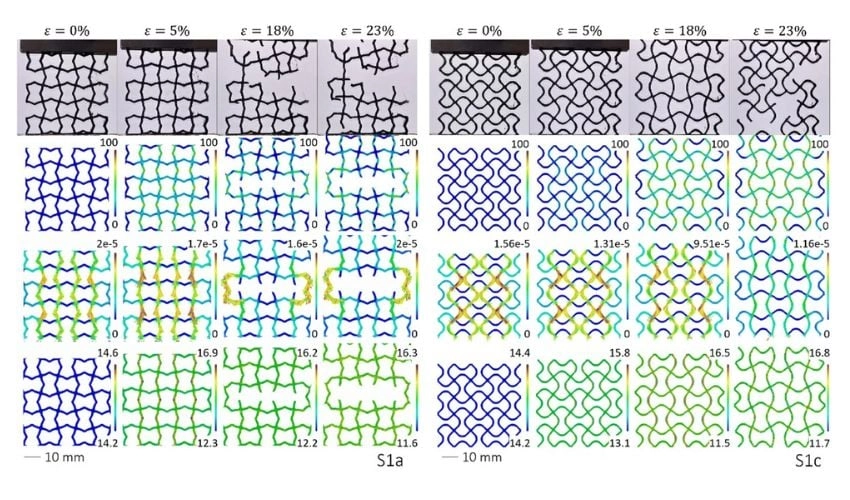
Researchers at the University of Glasgow have achieved a groundbreaking advancement by developing a new type of auxetic material through 3D printing. Unlike conventional materials that thin out when stretched (like a rubber band), these auxetic plastics expand laterally when pulled. This unique behavior was achieved by carefully engineering their internal geometries using additive manufacturing techniques.
In late June, the team published their findings in "Materials Horizons". The research indicates the potential to create self-monitoring materials with properties that can be programmed to be strength-sensitive, stretchable, and responsive to strain. The auxetic materials produced are not only mechanically robust, providing superior energy absorption and damage tolerance, but also have promising applications across various industries.
To fabricate these innovative structures, the researchers utilized an Apium P220 3D printer, creating them from PEEK (polyether ether ketone) – a strong thermoplastic known for its heat and wear resistance. PEEK can even replace some metals due to its favorable strength-to-weight ratio and biocompatibility, making it suitable for engineering and biomedical applications.
Professor Shanmugam Kumar, one of the study’s authors, explained that they’ve designed PEEK lattices that are not only auxetic but also capable of sensing strain and damage without any embedded electronics. This self-sensing ability stems from piezoresistivity, a phenomenon that allows the material to measure how it is stretched or compressed. The incorporation of carbon nanotubes into the PEEK feedstock enhances its electrical conductivity, allowing conversion of mechanical changes into measurable resistance variations.
The lattices were created using a repeating double-ended ‘Y’ structure that enables a rich variety of designs. By altering parameters such as thickness and angle, the team was able to compile an extensive catalog of materials showcasing different levels of auxeticity, stiffness, and sensitivity to strain.
Alongside the crafting of these materials, a computational model was developed to predict how the structures would respond under varying loads, enabling the optimization of material properties prior to physical fabrication. Kumar remarked on the potential for a “design for failure” philosophy in engineering, suggesting that these materials can not only be strong and lightweight but also intelligent in monitoring their integrity over time.
This study builds upon previous research wherein the team explored PLA (polylactic acid) infused with carbon black to create a variety of auxetic structures, suitable for temporary applications such as smart scaffolds in biomedical implants. In contrast, the new PEEK materials offer opportunities for permanent, load-bearing applications in more demanding environments.
Possible applications for the PEEK-based materials include smart orthopedic implants, aerospace components, and wearable technology, as well as impact-resistant structures for vehicles. Kumar summarized the potential innovations this research could spark, stating, “We’re essentially giving designers a toolkit for building the next generation of multifunctional materials, ones that are as intelligent as they are strong.”
For further insights, you can access the full study HERE.