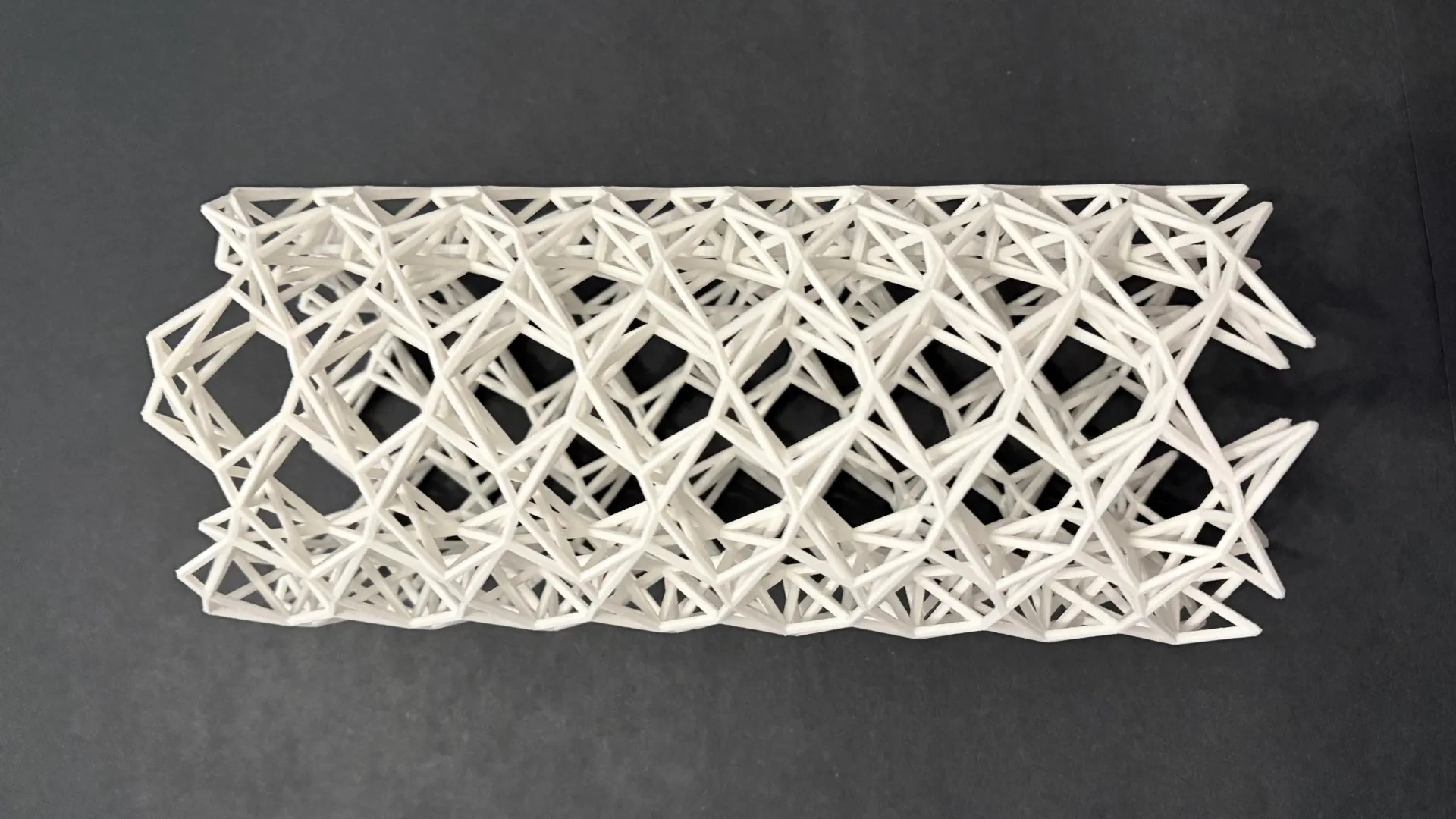
Scientists from the University of Michigan and the Air Force Research Laboratory (AFRL) have developed a groundbreaking method of 3D-printing intricate tubular materials capable of blocking vibrations. These structures, known as "kagome tubes," utilize geometric designs to achieve properties that traditional materials cannot offer. Such advancements could have significant implications for various industries, including transportation and construction.
The team’s findings, recently published in Physical Review Applied, stem from years of theoretical research and computer modeling, leading to tangible applications in vibration isolation. James McInerney, a research associate at AFRL and one of the study’s authors, emphasized the practical realization of creating structures that can effectively disrupt vibrations.
This project was partly funded by the Defense Advanced Research Projects Agency (DARPA) and the Office of Naval Research, alongside contributions from various academic and research institutions. The researchers are not modifying the chemical properties of materials but instead exploiting the principles of geometry. This approach mirrors natural designs found in nature, such as the structure of human bones and the shells of plankton, which utilize intricate arrangements to enhance strength and resilience.
McInerney expressed optimism about the potential of these materials, highlighting that as our manufacturing techniques evolve with precision 3D printing, it opens the door to creating new, architecturally unique materials. He stated, "The question we’re asking is, ‘What can we do with that?’ How can we create new materials that are different from what we’re used to using?’"
Historical perspectives from figures like James Clerk Maxwell and later advancements in topology have also played a role in shaping this field, illustrating how geometric configurations can lead to novel mechanical behaviors. The researchers managed to fabricate these "kagome tubes" with 3D-printed nylon, marking a significant step toward realizing the practical applications of mechanical metamaterials.
However, challenges remain. The study indicates that structures designed for optimal vibration suppression might sacrifice weight-bearing capability, prompting further inquiries into how these innovative materials can be effectively utilized and tested. As new standards for testing and evaluating such materials are developed, researchers are poised to unlock further applications in engineering and design.
For further reading, here is the related journal reference:
- James P. McInerney, Othman Oudghiri-Idrissi, Carson L. Willey, Serife Tol, Xiaoming Mao, Abigail Juhl. Topological polarization of kagome tubes and applications toward vibration isolation. Physical Review Applied, 2025; 24 (4) DOI: 10.1103/xn86-676c