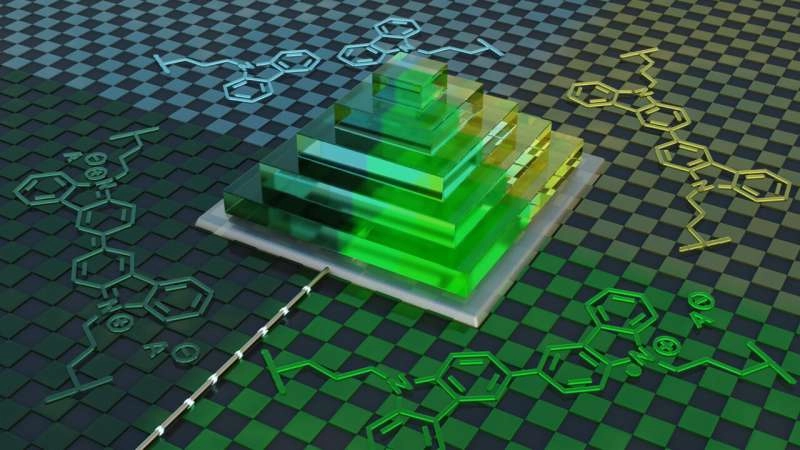
Creating electrically conductive 3D structures that can change color has long posed a challenge for optoelectronic applications. Traditional 3D printing techniques often fall short, lacking materials that blend conductivity with electrochemical switchability. This limitation has restrained their applicability in areas like pixel displays and soft robotics where dynamic and controllable substances are essential.
Researchers at the universities of Heidelberg and Stuttgart have tackled this limitation with a novel methacrylate-based "ink" infused with redox-active carbazole groups. These redox units impart the ability to donate or accept electrons, enabling the material to conduct electricity and undergo reversible color changes when stimulated electrochemically. The result is a printed structure that remains electrochemically responsive post-fabrication, allowing for pixel-level control in three-dimensional designs.
This innovative ink works seamlessly with digital light processing (DLP), a state-of-the-art 3D printing method that uses UV light to solidify layers of light-sensitive ink with precision. The researchers successfully created 2D pixel arrays, checkerboard patterns, and multi-layered pyramids. These structures start as nearly transparent but, through electrochemical stimulus, can transition from light green to dark green and nearly black. Importantly, this color change is entirely reversible and can be manipulated in three dimensions, affecting both height and color.
Combining high-resolution, light-based 3D printing with electrochemically active redox polymers paves the way for new advancements in additive manufacturing. This approach holds potential for designing 3D-printed optoelectronic devices, pixel displays, and soft robotic actuators that can alter their volume or color on demand. The research was conducted at the Institute for Molecular Systems Engineering and Advanced Materials, in collaboration with specialists in conducting polymers and electrochemical switching at the Institute of Polymer Chemistry.
For more insights on this topic and the latest advancements in electronics, visit Electronics For You.