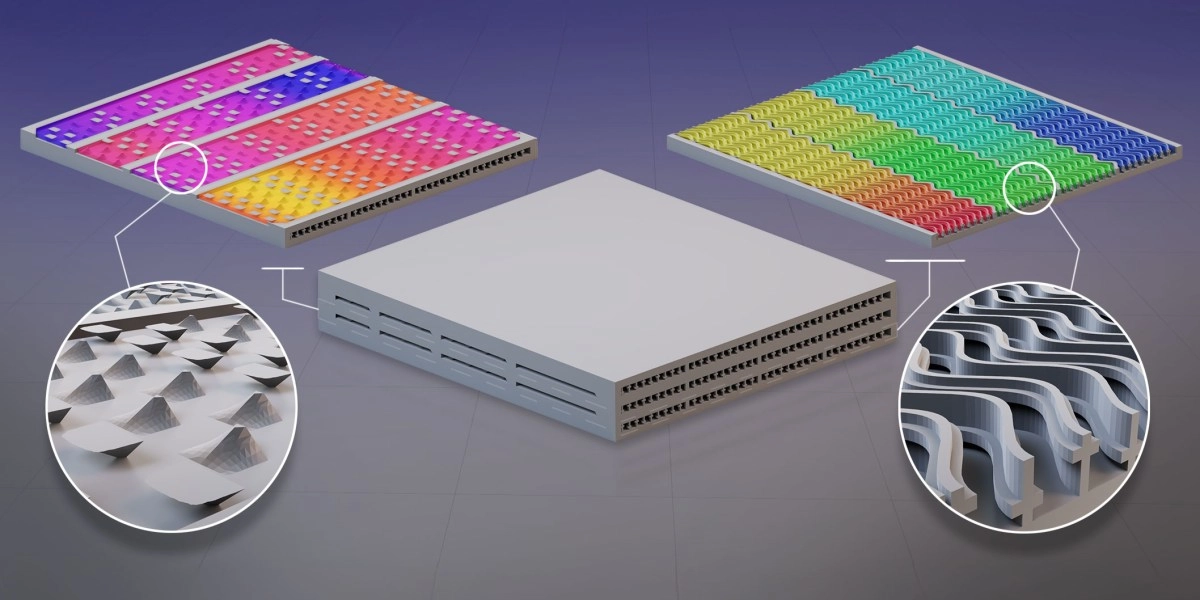
A novel design utilizing 3D printing has the potential to enhance heat exchangers, which are vital components in various cooling systems such as air conditioners and refrigerators. These devices efficiently transfer heat across their surfaces but have traditionally relied on standard designs that limit optimization.
William King, a professor from the University of Illinois Urbana-Champaign, emphasizes the crucial role of heat exchangers in energy systems, stating they are fundamental to modern machinery. Standard designs typically feature linear shapes and round tubes, which restrict their efficiency.
In their pursuit of a more effective design, King and his researchers utilized 3D printing techniques to create heat exchangers with innovative features, including wavy walls and pyramid-shaped bumps—design elements that are challenging to produce through conventional manufacturing methods.
The research focused on refrigerant R-134a, commonly found in cooling systems. The optimal cooling mechanism involves maximizing the contact area between the refrigerant and cold water, akin to the difference in cooling experienced by lying on ice versus touching it with gloved hands.
To arrive at the most effective design, the researchers ran 36,000 simulations and predicted performance outcomes using machine-learning models. They identified key components such as small fins along the water-contacting surface to increase heat transfer and wavy passageways for enhanced surface area exposure.
Further, on the refrigerant side, pyramid-shaped bumps not only improved cooling surface area but also promoted better mixing of the refrigerant, preventing the formation of a liquid layer that could hinder heat transfer.
Using direct metal laser sintering, a 3D printing technique that fuses metal powder with lasers, the researchers fabricated the heat exchanger design. Testing revealed that their design could cool refrigerant far more efficiently than traditional models, achieving a notable power density that exceeds conventional designs by 30% to 50% at the same pumping power.
While this new technique shows promise, researchers recognize that additive manufacturing remains costly and slow compared to traditional processes, making broad application in everyday cooling systems currently impractical. However, it may find specific uses in high-end sectors like aerospace and automotive where budget is less of a concern.
The study was underpinned by funding from the US Office of Naval Research, motivated by the increasing thermal management demands of next-generation vessels that feature more electronics. Amid projections indicating a doubling of energy demand for cooling by 2050, innovative designs like this could play a pivotal role in fostering efficiency.
Overcoming manufacturing costs and outdated efficiency standards will be crucial for bringing such advancements to market. As it stands, industry leaders indicate that while the tech is promising, it will not necessarily lead to immediate changes in consumer cooling products.
Relevant to this discussion: