A breakthrough in 3D printing technology could revolutionize heat exchangers, crucial components in cooling systems such as air conditioners and refrigerators, making them smaller and more efficient. Heat exchangers are ubiquitous in various industries, from data centers to ships, where they transfer heat from one side to another. Traditionally, these devices have relied on straightforward designs that are easiest to manufacture.
William King, a professor at the University of Illinois Urbana-Champaign, emphasizes the significance of heat exchangers, referring to them as essential to the industrial economy and energy movement systems. The traditional designs favor straight lines and right angles, which limit optimization for heat transfer.
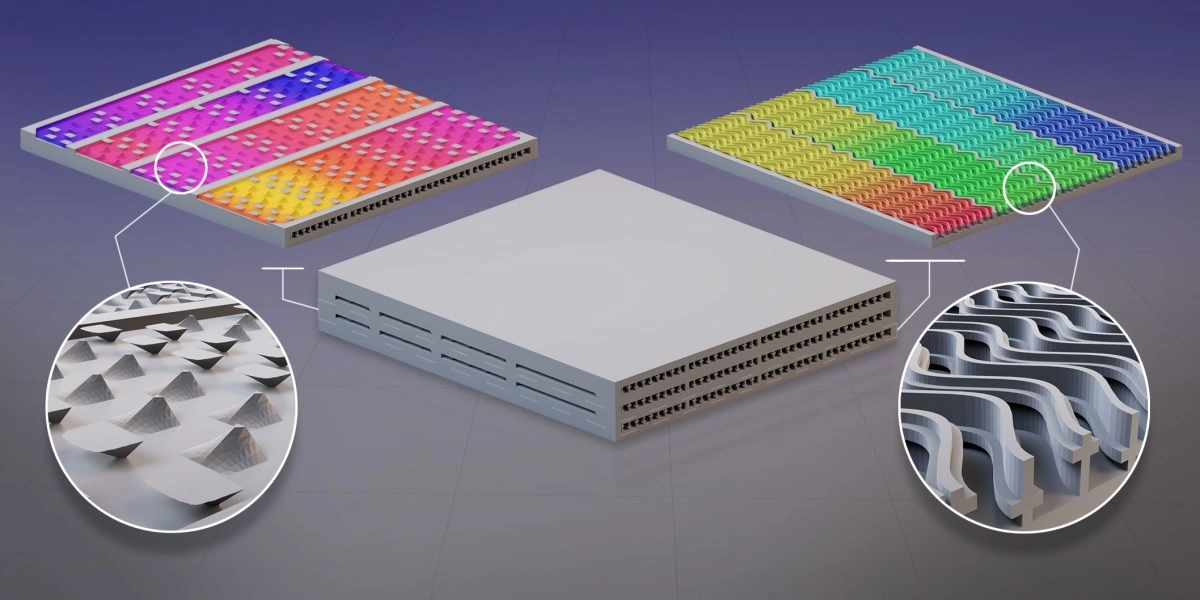
In their research, King and his colleagues utilized 3D printing to create a heat exchanger featuring enhanced designs, such as wavy walls and pyramid-shaped bumps. These innovations facilitate more effective heat transfer than conventional manufacturing methods allow.
The team focused on R-134a, a common refrigerant in cooling systems. Efficiently cooling this refrigerant is vital, as it transitions from gas to liquid when cooled, facilitating heat removal in various applications. The researchers found that the best cooling occurs with thin walls that allow maximum contact between the refrigerant and water.
To reach the optimal heat exchanger design, the team employed simulations and machine-learning models, running 36,000 simulations to identify the most effective configuration. The resulting design incorporated small fins on the water side, enhancing surface area, and wavy passages for increased heat transfer. On the refrigerant side, pyramid-shaped bumps were added to improve cooling and prevent a liquid film from forming, which could hinder heat transfer.
Using a 3D printing method known as direct metal laser sintering, the team constructed the heat exchanger with an aluminum alloy. Testing showed this new model could cool refrigerant far more efficiently than conventional designs, achieving a power density over six megawatts per cubic meter—30% to 50% better than standard shell-tube designs.
Although this innovative design does not significantly surpass existing technologies, it marks a promising approach for future development in heat exchanger design, according to Dennis Nasuta from Optimized Thermal Systems. However, he noted that the current slow and costly nature of 3D printing limits its practicality for widespread consumer use.
The U.S. Office of Naval Research funded this study, highlighting the increasing need for compact and efficient cooling systems in modern ships, which house more electronics generating heat than before.
With projected energy demand for cooling quadrupling by 2050, finding more efficient cooling solutions is crucial. However, challenges such as manufacturing costs and existing industry standards must be addressed for these advancements to be adopted widely. As Nasuta points out, new manufacturing practices will take time to integrate into everyday cooling devices.