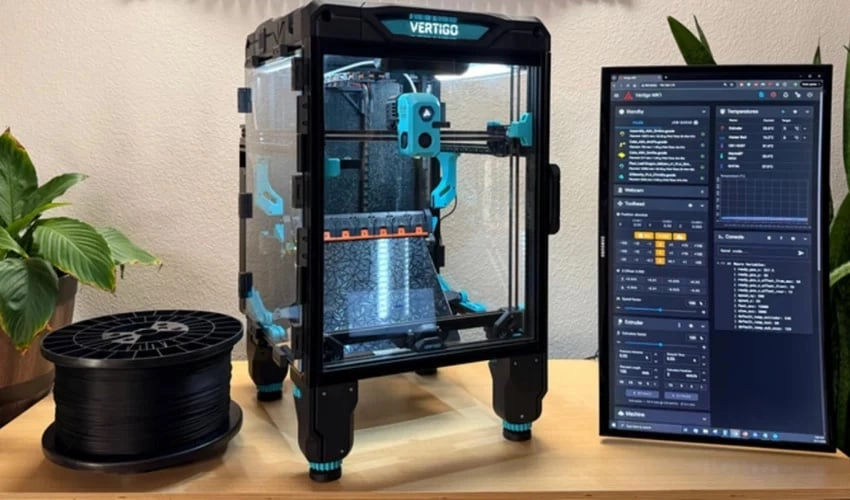
In recent years, the demand for automation in 3D printing has surged, particularly among professional environments and print farms aiming to enhance efficiency while minimizing manual intervention. The Vertigo MK1, a new 3D printer currently seeking funding on Kickstarter, aims to address these needs with its innovative auto-ejection system.
Developed by Automated Layers, the Vertigo MK1 seeks to transform the limitations encountered in conventional printers, ensuring it remains accessible for both professionals and enthusiasts. The printer features a heated build plate that can reach temperatures of up to 120°C and a print chamber maintained at 50°C, making it compatible with a diverse array of filaments.
Features of the Vertigo MK1
The standout feature of the Vertigo MK1 is its integrated auto-ejection system for printed parts. In contrast to traditional methods that often rely on the print head to push out completed items, or require expensive external modifications, the MK1 has a built-in ejection mechanism. After each print, the heated bed rotates 90°, cools rapidly with the aid of four fans, and uses a nylon scraper to gently remove the print without damaging the surface or impacting the movement system. This method enhances compatibility with various geometries and materials.
Key Technical Specs:
- Heated Chamber: Maintains an internal temperature of 50°C to support the printing of technical materials like ABS and ASA, reducing deformation risks.
- Heated Print Bed: Reaches 120°C in under two minutes and cools three times faster due to integrated fans.
- CoreXY System: Achieves print speeds of 300 mm/s and accelerations up to 30,000 mm/s² based on theoretical values.
- Automatic Leveling: Utilizes an E3D Revo PZ probe for optimized first-layer printing.
- Open-Source Design: The MK1 is inspired by Voron printers, making it fully open-source.
The Rationale Behind Automation
Automated Layers created the MK1 to resolve frustrations commonly faced in their print farm, where they encountered issues with traditional automation. Existing approaches often suffered from reliability concerns and limitations with material compatibility. The MK1 is designed to facilitate continuous printing, thereby reducing the need for human oversight and optimizing printer utilization. Internal testing indicated the potential for uninterrupted printing for up to 200 hours, using 5 kg of filament without any human interaction—a promising feat for a prototype.
Competing Solutions in the Market
The Vertigo MK1 is not alone in offering auto-ejection in 3D printing; several alternatives exist, each presenting its unique features and challenges:
-
Robotic Arms (e.g., Mira from Cosmyx) – Best suited for industrial use, this system involves a substantial investment for smaller operations.
-
Modular Systems (e.g., Array from Mosaic Manufacturing) – Combines multiple printers with automated material management, ideal for high-volume production but also a significant financial commitment.
-
Conveyor Belt Printers (e.g., Creality CR-30) – Enables mass production but poses issues with print head orientation and leveling.
-
Head Ejection Systems – Utilize customizable G-code for part ejection post-printing; however, this method can damage fragile prints or affect the printer.
The MK1 offers a compact, all-in-one solution from the outset, emphasizing automated ejection without requiring additional modifications.
Funding Success on Kickstarter
The Kickstarter campaign for the Vertigo MK1 has successfully surpassed its initial funding goal of $25,000, almost doubling it as of the latest updates. Several backing options are available, including:
- Hardware Kit (only hardware included): $2,250
- Standard Kit (fully assembled with parts): $2,625
- Assembled Unit: $5,000
Despite the excitement surrounding the campaign, the inherent risks of crowdfunding, particularly concerning production and delivery timelines, remain a consideration. The anticipated delivery date is set for May 2025, and interested parties can follow the project’s progress on its Kickstarter page.
The Vertigo MK1 presents an innovative step toward eliminating manual tasks traditionally associated with 3D printing. It will be intriguing to see how it performs in real-world applications once it becomes available.