Manufacturing could undergo significant transformation thanks to two innovative techniques for material joining developed by scientists in Austria. These methods form exceptionally strong bonds at the microscopic pore level, bypassing the need for harsh chemical adhesives.
While industrial adhesives effectively connect components, they pose environmental challenges, particularly those derived from petroleum. The production of these adhesives consumes substantial energy and resources, emits pollutants, and the adhesives can contaminate soil and groundwater at the end of their lifecycle. Moreover, certain chemicals in adhesive production may pose health risks to workers.
Efforts to develop environmentally friendlier adhesives have included initiatives like a reusable plant-based glue and a biodegradable adhesive. However, researchers at Graz University of Technology (TU Graz) in Austria have pioneered alternative strategies, effectively bonding various woods with plastics, stainless steel, and titanium alloys.
One innovative method they explored is called “Addjoining.” This technique involves 3D printing materials directly onto untreated wood, integrating into the wood’s pores and creating a bond similar to traditional adhesives, which was then subjected to a strength test by breaking the bond.
“After the (bond) fractured, we were able to find polymer in the wood pores and broken wood fibers in the polymer, which suggests that the fracture occurred in the wood and polymer, but not at the joint,” explains Gean Marcatto, who worked on this process as a postdoc at TU Graz’s Institute of Materials Sciences, Joining and Forming.
The team believes that the 3D-printed bonds could be made even stronger if the wood was etched using lasers to create more complex structures or larger pores for the other material to bond with.
“But we wanted to work with as few steps as possible and, above all, without chemicals,” says Sergio Amancio, who led the research. “We can use this technology particularly well with complicated 3D geometries because the components are printed directly onto the surface – in whatever geometry is required.”
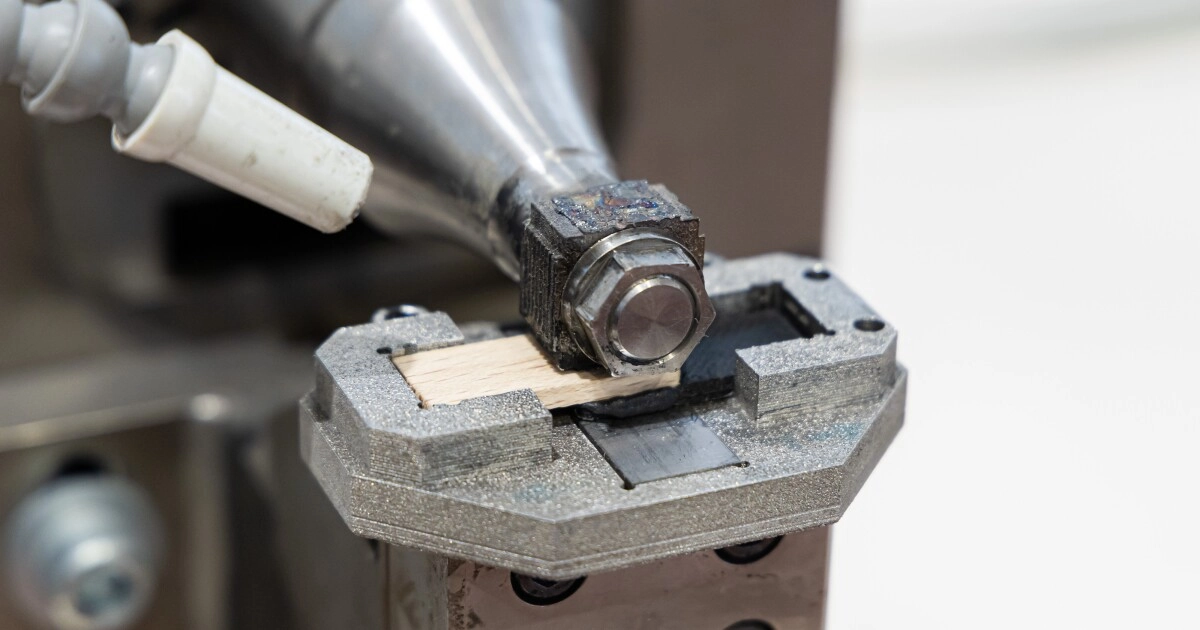
The second joining technique the researchers came up with was called “Ultrasonic Joining.” It used an instrument called a sonotrode to send high-frequency, low vibration waves through the juncture of the wood and the metal polymers. This created friction, which generated enough heat to bond the two materials together.
“This technique is particularly suitable for large components and 2D structures since we achieve a precisely localized spot joint,” says Awais Awan, a co-author on the study.
The researchers believes their new green joining techniques can have applications in the furniture, automotive and airline industries.
Their research has been presented at the IIW Annual Assembly and International Conference on Welding and Joining held last month in Rhodes, Greece.
Source: TU Graz