When you buy through links on our articles, Future and its syndication partners may earn a commission.
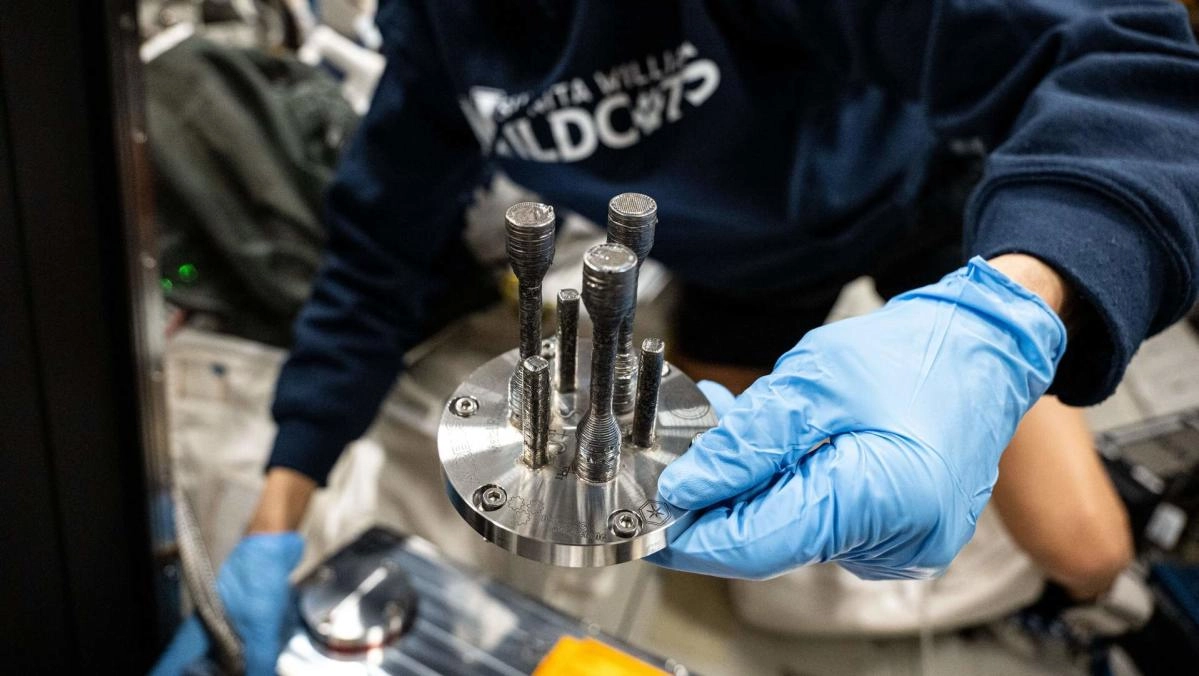
Scientists on the International Space Station (ISS) have achieved a groundbreaking milestone by successfully 3D printing a metal part in space for the first time. This achievement marks a significant advancement as 3D metal printing is considered crucial for the success of future prolonged space missions. The team from the European Space Agency (ESA) faced and overcame numerous challenges to establish the capability to manufacture metal components in orbit. They aim to create four metal 3D printed components, which will be sent back to Earth for extensive quality assurance tests.
The pioneering device responsible for this achievement is ESA’s Metal 3D Printer, a technology demonstrator developed by Airbus and its partners. The intricate work of devising the printer’s melting process and its associated hardware, including the laser source and delivery optics, feedstock storage, and feeding system, was primarily conducted at Cranfield University in the UK, according to an ESA press release.
Earlier in the year, the ESA Metal 3D Printer was transported to the ISS, and ESA astronaut Andreas Mogensen was responsible for installing this intricate payload. The initial successful 3D print of a metal component occurred in August.
“With the printing of the first metal 3D shape in space, ESA Exploration teams have achieved a significant milestone in establishing in-orbit manufacturing capabilities,” said Daniel Neuenschwander, Director of Human and Robotic Exploration at ESA. “This accomplishment, made possible by an international and multidisciplinary team, paves the way for long-distance and long-duration missions where creating spare parts, construction components, and tools on demand will be essential,”
In-orbit success has previously been enjoyed using 3D printers fed by plastic filament, but of course metal parts are sometimes desirable for their heat resistance, mechanical strength, and overall durability. The microgravity conditions on the ISS, and other space stations, can play havoc with standard 3D printer designs. Moreover, the ESA Metal 3D Printer sounds like quite a beast, which melts stainless steel filament at 2,192°F (1,200°C) and then additively creates the desired objects layer-by-layer.
As mentioned in the intro, the first four finished 3D-printed metal components are going to be sent back to Earth for study. Two parts are heading to the Netherlands, one to Germany, and another to Denmark. The respective institutions will be looking closely at the quality of the in-space manufactured parts.