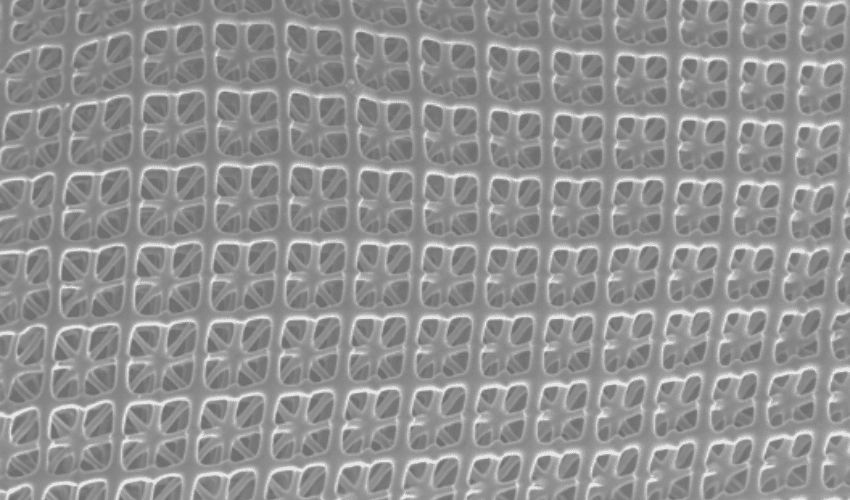
Researchers at the University of Toronto have made a significant breakthrough in materials science by developing nano-architected materials that offer the strength of carbon steel and the lightness of polystyrene foam, utilizing machine learning and 3D printing technologies. This advancement highlights 3D printing’s growing role in creating innovative materials with advantageous properties across diverse industries.
Led by Professor Tobin Filleter, the research team focused on creating nanomaterials characterized by their robustness, lightweight nature, and adaptability. These materials are composed of small, repetitive units just a few hundred nanometers in size, which can be stacked to match the thickness of a human hair. These carbon-based units arrange into complex 3D structures known as nanolattices.
Peter Serles, one of the lead researchers, noted that nano-architected materials employ high-performance shapes, leveraging the principle that smaller structures can be stronger. Traditional lattice designs have inherent limitations due to stress concentrations at sharp intersections, leading to premature failure. Serles identified this challenge as an ideal candidate for machine learning solutions.
Collaborating with the Korea Advanced Institute of Science & Technology (KAIST), the team applied a machine learning algorithm to optimize material shapes for enhanced strength and reduced weight. They then utilized a two-photon polymerization 3D printer to produce prototypes at micro and nanoscale. The resulting nanolattices exhibited more than double the strength compared to earlier models, demonstrating the ability to withstand a stress of 2.03 megapascals per cubic meter per kilogram—approximately five times that of titanium.
Serles expressed astonishment at the results, emphasizing that the machine learning application not only replicated known successful geometries but also innovated new designs. The efficient Bayesian optimization algorithm required only 400 high-quality data points for its calculations, vastly more efficient than traditional methods that may need tens of thousands of examples.
These new lightweight, strong materials are poised to impact several fields, particularly aerospace, where they can enhance fuel efficiency without compromising safety or performance. Additional information on their findings can be accessed through their research paper here.