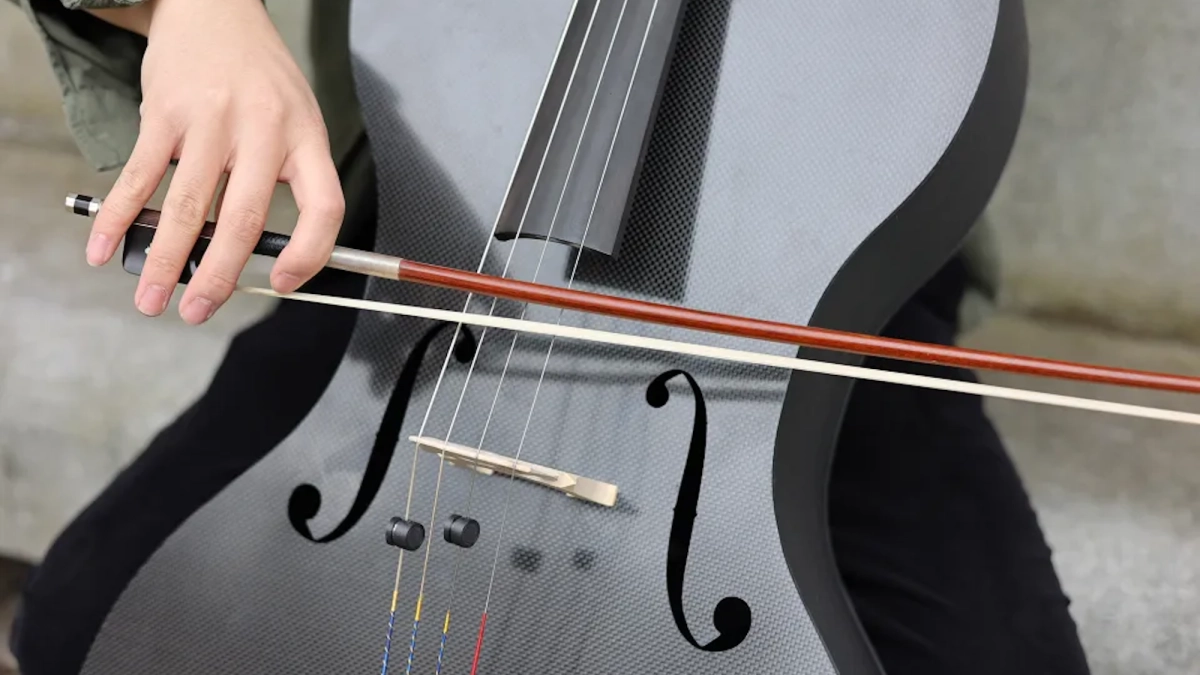
3D printing technology has evolved significantly, moving well beyond basic plastic models to create sophisticated and high-quality products. One recent innovation comes from a former Yale University student, Elijah Lee, who has introduced a new kind of musical instrument: 3D-printed cellos made from carbon fiber and polymers.
The cello, known for its rich sound and complex design, traditionally involves a mix of materials and craftsmanship that has historically made it an expensive investment. While entry-level cellos are priced around $600, concert-grade instruments can cost upwards of $15,000. Additionally, maintaining these wooden instruments requires regular care, presenting further barriers for aspiring musicians.
In response to these challenges, Lee founded Forte3D, a company dedicated to creating customizable string instruments. He began his journey in high school when he explored the intersection of music and engineering through 3D printing, inspired by a suggestion from his orchestra director to design a cello.
Forte3D’s cellos are not mere replicas of traditional instruments; they incorporate innovative designs that leverage the unique properties of carbon fiber. Unlike the rounded bodies of typical wooden cellos, these instruments feature flat and concave carbon fiber panels, with the neck and ribs crafted from 3D-printed polymer. However, to preserve the familiar tonal qualities, essential components like the bridge, sound post, and fingerboard are still made of wood. This design flexibility allows for individual customization in terms of thickness, shape, and material.
After gaining attention from investors on the show Shark Tank, Lee plans to expand his product offerings beyond just cellos, with a 3D-printed violin already available and plans for violas and double basses in the works. He aims to enhance the accessibility and durability of musical instruments, ensuring that cost does not hinder one’s ability to pursue music.
Currently, the prices of Forte3D’s cellos and violins are around $3,000 and $1,500, respectively, making them a more affordable alternative to many traditional options. With anticipated growth and institutional support, there is potential for these instruments to reach schools and music programs, breaking down the barriers that have historically separated people from the joy of making music.