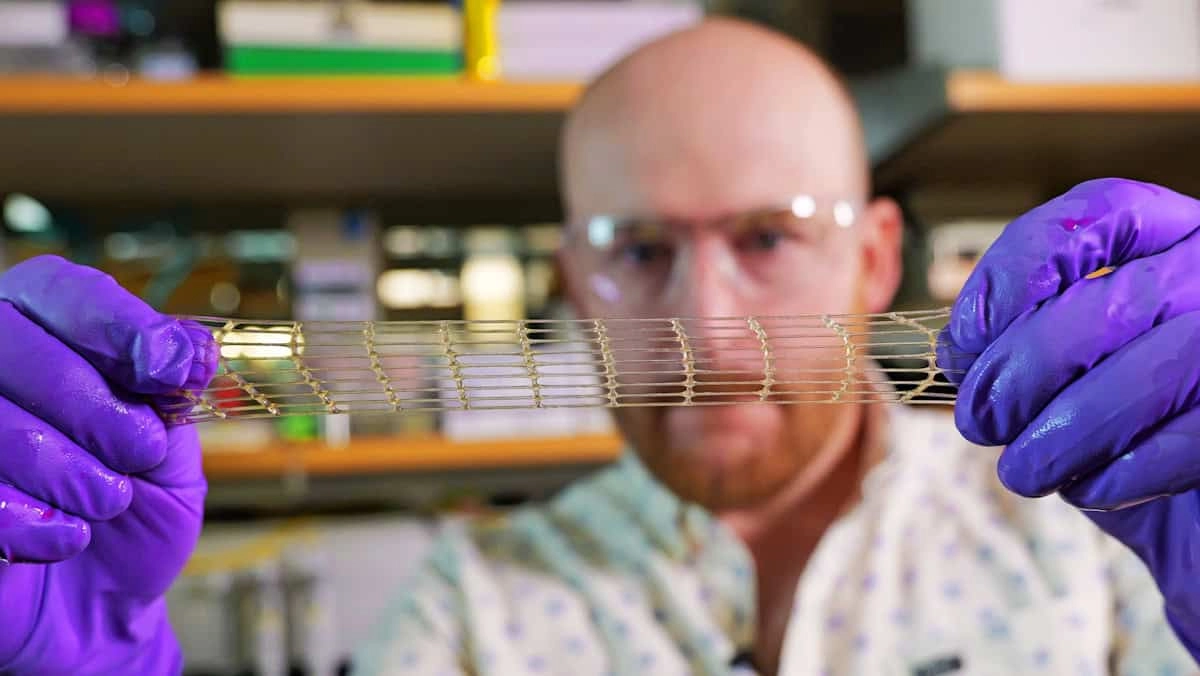
A new technique in 3D printing, highlighted in Science, is advancing the use of hydrogel-based adhesives in medical settings.
3D printers, by layering different materials, facilitate the crafting of intricate shapes and structures. In medical scenarios, there is a demand for biomaterials that are not only strong and stretchable but can also adhere to moving biological tissues such as a pulsating heart or the tough cartilage at bone joints.
A field of particular interest involves the creation of tissues, organs, and implants through 3D printing using hydrogels – materials derived from networks of crosslinked polymer chains. Although there has been substantial advancement in hydrogel technology, traditional 3D printed hydrogels tend to either tear under strain or crack under pressure, with some being overly rigid for use around pliable tissues.
Researchers from the University of Colorado Boulder in collaboration with the University of Pennsylvania and the National Institutes of Standards and Technology (NIST) have developed a method to enhance the resilience and elasticity of 3D printed hydrogels. This approach, known as CLEAR, uses spatial light illumination (photopolymerization) to define the shape, while a concurrent redox reaction (dark polymerization) progressively forms a dense network of interwoven polymer chains, potentially enabling these materials to better adhere to moist tissues.
To their knowledge, the researchers say, this is the first time that light and dark polymerization have been combined simultaneously to enhance the properties of biomaterials fabricated using digital light processing methods. No special equipment is needed – CLEAR relies on conventional fabrication methods, with some tweaks in processing.
“This was developed by a graduate student in my group, Abhishek Dhand, and research associate Matt Davidson, who were looking at the literature on entangled polymer networks. In most of these cases, the entangled networks that form hydrogels with high levels of certain material properties…are made with very slow reactions,” explains Jason Burdick from CU-Boulder’s BioFrontiers Institute. “This is not compatible with [digital light processing], where each layer is reacted through short periods of light. The combination of the traditional [digital light processing] with light and the slow redox dark polymerization overcomes this.”
Experiments confirmed that hydrogels produced with CLEAR were fourfold to sevenfold tougher than hydrogels produced with conventional digital light processing methods for 3D printing. The CLEAR-fabricated hydrogels also conformed and stuck to animal tissues and organs.
“We illustrated in the paper the application of hydrogels printed with CLEAR as tissue adhesives, as others had previously defined material toughness as an important material property in adhesives. Through CLEAR, we can then process these adhesives into any structures, such as porous lattices or introduce spatial adhesion that may be of interest for biomedical applications,” Burdick says. “What is also interesting is that CLEAR can be used with other types of materials, such as elastomers, and we believe that it can be used across broad manufacturing methods.”
Ultrasound-activated sono-inks could print 3D structures inside the human body
CLEAR could also have environmentally friendly implications for manufacturing and research, the researchers suggest, by eliminating the need for additional light or heat energy to harden parts. The researchers have filed for a provisional patent and will be conducting additional studies to better understand how tissues react to the printed hydrogels.
“Our work so far was mainly proof-of-concept of the method and showing a range of applications,” says Burdick. “The next step is to identify those applications where CLEAR can make an impact and then further explore those topics, whether this is specific to biomedicine or more broadly beyond this.”
Note: The verification e-mail to complete your account registration should arrive immediately. However, in some cases it takes longer. Don’t forget to check your spam folder.
If you haven’t received the e-mail in 24 hours, please contact customerservices@ioppublishing.org.
A step-by-step guide unlocking your research’s scientific impact