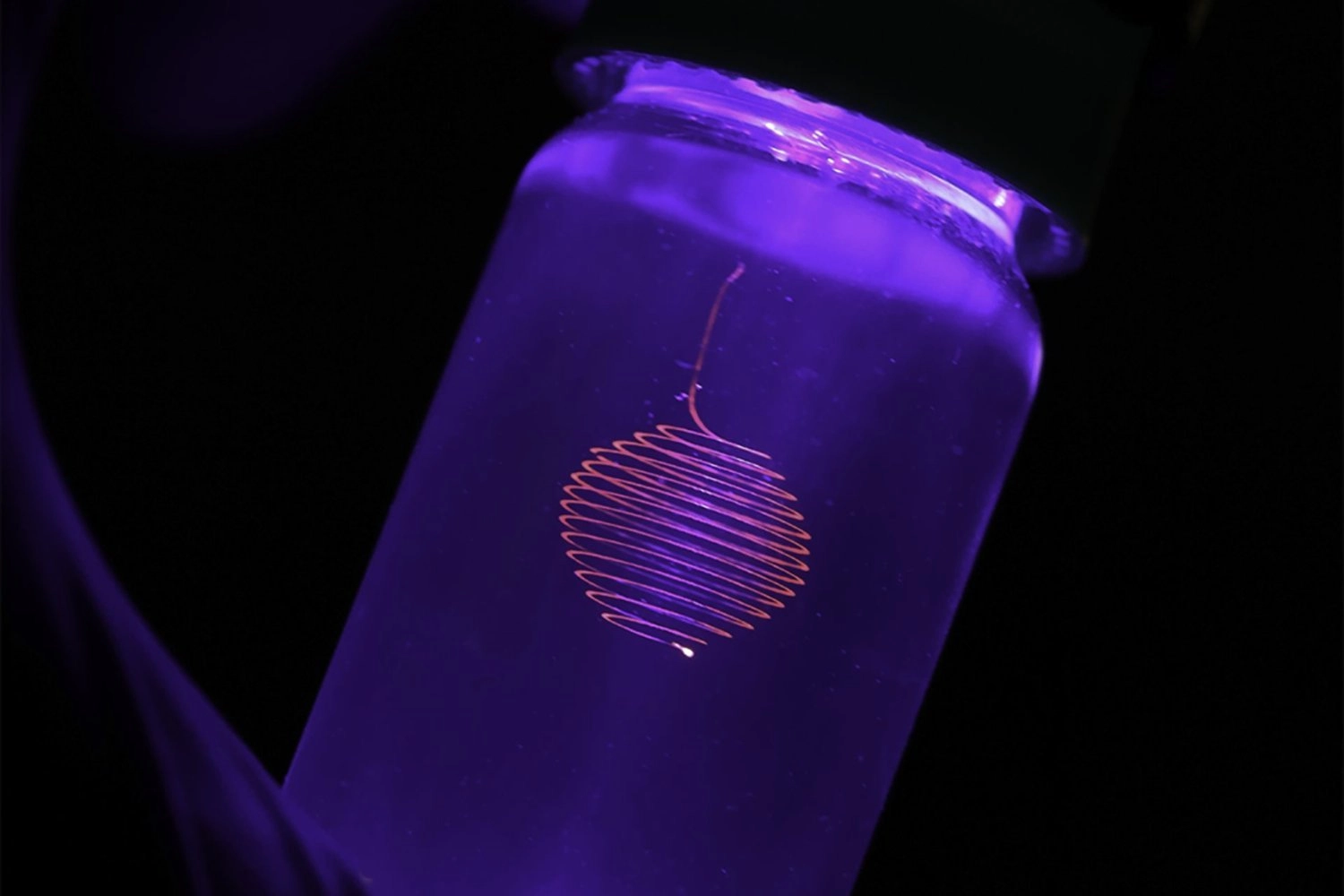
Researchers have achieved a significant advancement in 3D printing by creating fibers with a thickness of just 1.5 microns, inspired by the natural qualities of spider silk and hagfish slime. This breakthrough, published in Nature Communications, marks an exciting leap forward in the capabilities of 3D printing technologies, particularly in crafting soft and delicate materials.
The team, including engineer Mohammad Tanver Hossain from the University of Illinois Urbana-Champaign, used a novel method known as embedded printing. This technique allows for material deposition into a gel mold, differing from traditional printing that constructs objects layer by layer from the bottom up. This method supports the materials being printed, making it feasible to create complex structures previously unobtainable with standard 3D printing methods.
Before this approach, the challenge lay in curing these hair-thin structures without them breaking. Hossain’s team modified both the gel and printing ink to allow immediate solidification upon deposition, preventing breakage during the curing process. Their ability to print fibers as thin as 1.5 microns compares starkly to traditional paper, which typically ranges from 50 to 200 microns in thickness.
This high-resolution printing capability paves the way for replicating a variety of natural structures, which often boast unique functional properties. Wonsik Eom, a co-author of the study, noted that this development allows engineers to mimic both microfibers and diverse hair-like structures found in nature.
Their inspiration for this technology stems from hagfish, marine creatures that produce a versatile slime for defense and hunting. By employing embedded 3D printing to imitate these natural threads, the researchers discovered that enhancing printing techniques could yield a broader spectrum of natural structures than initially anticipated.
The importance of this breakthrough extends to fabricating intricate 3D hair-like structures without the hindrance of gravity that typically affects traditional printing methods. Sameh Tawfick, another co-author, emphasized the ability to use ultraprecise 3D printers to create such designs, showcasing the potential of bioinspired 3D printing.
This research not only highlights the innovative strides in technology but also serves as a reminder of the astonishing engineering concepts found in nature itself.
For more information on this study, visit the published article in Nature Communications here.