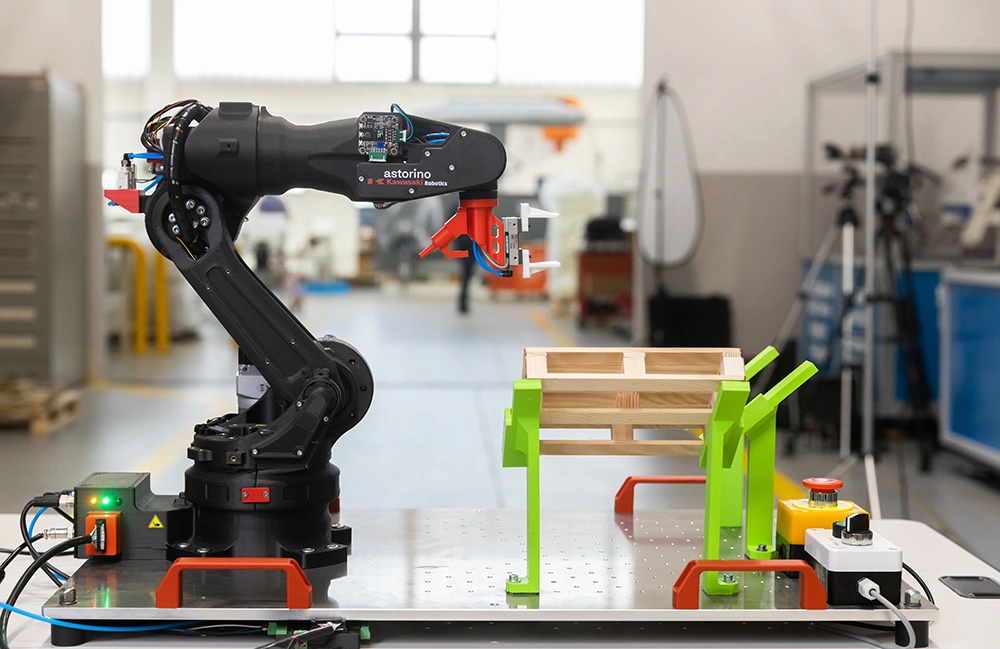
Kawasaki Robotics has launched a new robotic platform named Astorino, targeted at enhancing the practical learning experience in industrial and technical educational environments. This platform stands out for its affordability, adaptability, and focus on safety, providing features comparable to contemporary industrial robots but within a budget-friendly price range, making it a great resource for educators.
Astorino aims to cultivate essential robotics skills among students, by enabling them to operate a robot much like Kawasaki’s industrial units. Kawasaki Robotics suggests that mastering Astorino could equip learners with the skills needed to handle any robot from their range.
One distinctive element of Astorino is its 3D-printed framework, contributing to its much lighter weight of approximately 12 kg (26.4 lb.). This not only decreases the manufacturing costs but also makes Astorino a suitable choice for educational environments where safety is paramount. Unlike traditional robots that use servo motors, Astorino employs stepper motors, further emphasizing its suitability for educational use.
“This robot isn’t designed to perform automated tasks but to serve as a teaching tool,” explained Alexandre Boffi, Kawasaki’s manager of general industries. “Because it’s 3D printed and uses step motors, it’s much safer for students to handle and operate.”
The robot has a 1 kg (2.2 lb.) payload and is equipped with a six-axis system, mirroring the structure and programming environment of Kawasaki’s industrial robots. Students can safely learn to program complex robotic movements and operations with a system that behaves like a larger industrial model without the same safety risks.
At a base price of $5,000, Astorino is much more affordable than other educational robots, allowing schools and universities to purchase multiple units. This affordability increases student engagement, as more students can have direct interaction with the robots during lab sessions.
“With Astorino, instead of having one robot for an entire class, educators can now purchase several units,” Boffi said. “For the price of one industrial robot, you could get up to five Astorinos, giving students more time with the equipment.”
Kawasaki’s development of the Astorino robot aims not to rival major educational robot producers but to offer an easily accessible and versatile system. The robot operates on a 110V electricity source and is designed to seamlessly integrate into various educational settings.
Astorino is highly customizable, a critical attribute for educational purposes. Kawasaki makes available STL files for 3D-printing parts, enabling students or teachers to produce any necessary replacement parts themselves. “If a part breaks, students can print a replacement themselves,” stated Boffi. “Alternatively, a teacher might build the robot with students initially and follow up by teaching programming skills in subsequent lessons.”
The robot supports several customization features including different grippers, IO modules, and additional sensors, which allows educators to modify the setup based on specific instructional needs. Its stepper motors are designed for safe use by even young learners, and the lightweight construction of the robot assures adaptability across diverse learning environments.
Targeting educational bodies, Kawasaki’s Astorino seeks to fulfill the increasing demand for direct robotics experience. Data from the College Board indicates that the U.S. has over 174,000 robot engineering positions, projected to grow by 6.41% in the next five years, highlighting the growing importance of practical robotics knowledge in the evolving job market.
Astorino introduces a cost-effective, secure, and versatile platform aimed at facilitating robotics education. Plans from Kawasaki suggest enhancements to the platform, including introducing a seventh axis and further options for end-effectors.
This summary includes key specifications and pricing information for our selection of top consumer-grade 3D printers for 2024. It specifically highlights FDM printers… read more »
Infinity Turbine unveils a pioneering method in electrode production that merges fiber laser heat treatment, additive manufacturing, and laser-induced carbonization. More on this technology… read more »
3D Systems has achieved an important development milestone with its Oqton Manufacturing OS, designed to facilitate on-demand manufacturing solutions… read more »
Stratasys Ltd., in partnership with Materialise, has launched the Stratasys Neo Build Processor for Investment Casting, a tool aimed at boosting the… read more »
A novel manufacturing initiative orchestrated by Oak Ridge National Laboratory (ORNL) aims to rejuvenate U.S. manufacturing by enabling the creation of substantial metal parts for… read more »
During the 2024 Fall Maison&Objet event in Paris, the Hong Kong-based architectural firm LAAB revealed a sustainable pavilion made from 3D-printed bricks crafted from… read more »
The company specializing in cold spray additive manufacturing, SPEE3D, is set to introduce its new Expeditionary Manufacturing Unit (EMU) at the upcoming Land Forces expo occurring from Wednesday… read more »
Explore the collaboration between Edser and HP which utilizes 3D printing technology to develop a scoliosis brace that offers enhanced customization and performance.
Endeavor 3D, a contract manufacturer, has now received International Traffic in Arms Registration (ITAR) status for its polymer and metal additive manufacturing services. This… read more »
Stratasys has recently launched the Origin Two DLP 3D printer and its corresponding post-processing solution, Origin Cure, catering to the increasing needs for high-quality, short-run production…. read more »