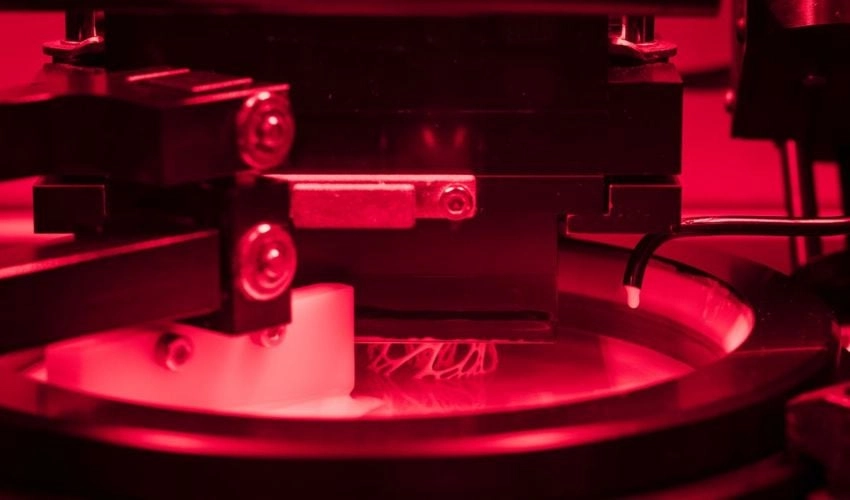
Last week, Hannover, Germany, hosted the annual Hannover Messe, a key event focused on manufacturing and digital transformation, where automation and technology take center stage. Among the exhibitors was a notable project from researchers at the Karlsruhe Institute of Technology (KIT), known as CeraMMAM (short for Ceramic Multi-Material Additive Manufacturing). This initiative aims to advance resin-based 3D printing by enabling the combination of ceramics and metals, along with various ceramic types, within a single build tank.
The CeraMMAM process employs photopolymerization, where a photosensitive resin, mixed with ceramic or metal particles and a binder, is cured under specific light wavelengths. The resulting printed parts will undergo debinding and sintering to reach their final form. The innovative aspect of this approach is its universal binder system, which consists of liquid polymers, functional additives, and a photoinitiator, necessary for achieving the desired material combinations.
According to the research team, this universal binder can create multi-material components with novel and sometimes contradictory properties, paving the way for unique designs and functionalities. For instance, they can produce ceramic gears with flexible interiors and hard outer surfaces.
So far, the researchers have successfully tested a ceramic-ceramic composite made from aluminum oxide and zirconium oxide, as well as combinations of alumina-reinforced zirconia and zirconia-reinforced alumina. The potential applications of CeraMMAM are vast, particularly in sectors like aerospace, healthcare, and mechanical engineering. This technique could revolutionize the manufacture of custom bone and dental implants and help create components resistant to wear and heat with precisely controlled properties.
For more information, visit the official Karlsruhe Institute of Technology page on this project.