By Evan Garcia
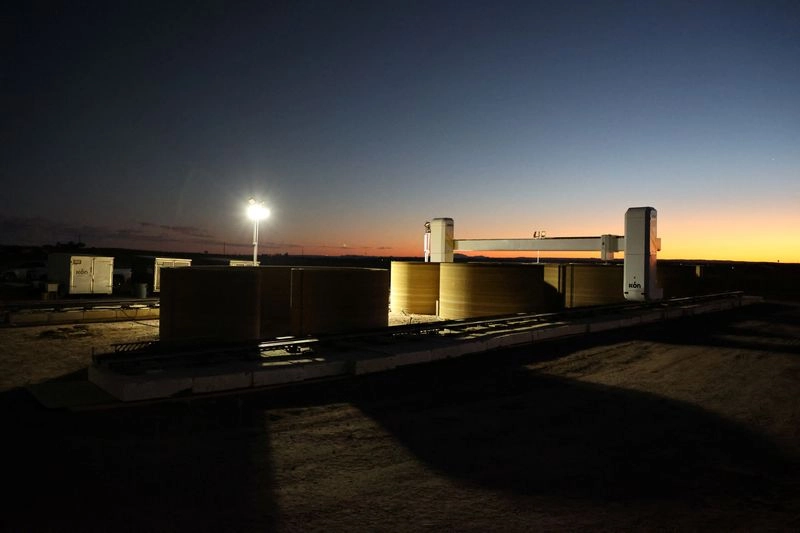
MARFA, Texas (Reuters) – This apparatus may resemble a standard 3D printer, but with the stature of a crane, it is currently constructing a hotel in the Texas wilderness.
Located on the periphery of Marfa, El Cosmico, a hotel and campground, is undergoing expansion. The project includes the addition of 43 new hotel units and 18 homes spread across 40 acres, all being created using a 3D printer.
This initiative marks the emergence of the world’s initial hotel structured entirely through 3D printing, as claimed by El Cosmico’s proprietor Liz Lambert, in collaboration with ICON, a 3D printing firm from Austin, Texas, and the architectural group Bjarke Ingels.
Lambert expressed that the technology fosters exceptional levels of creativity.
“Typically, hotels are confined within four walls with repetitive designs. I’ve never had the opportunity to construct with so few restrictions and such fluidity; the curves, domes, and parabolas present a novel construction method,” Lambert shared.
Lambert also noted that the technology permits the inclusion of architectural elements that would usually be prohibitively costly in traditional large-scale constructions.
The initial two structures being created are a three-bedroom residential area and a single-room hotel space, both featuring single-story, 12-foot high walls. These structures are constructed with the aid of ICON’s Vulcan, a 3D printer that spans 46.5 feet in width, stands 15.5 feet tall, and weighs 4.75 tons.
A print technician observes as the robotic arm of Vulcan smoothly operates over the construction site, mounted on a gantry system.
The raw material used in this 3D printing process is a unique cement mixture named Lavacrete, which is specially formulated for enhanced durability, cost-effectiveness, and printing efficiency. ICON’s CEO and founder, Jason Ballard, explains that the composition of this material is fine-tuned in response to the prevailing weather conditions.
“The real innovation is in the additives that enable ongoing printing,” noted Ballard, mentioning how factors like humidity, temperature, and sunlight exposure can influence the characteristics and even the eventual hue of the material.
Additionally, ICON is advancing their technology through the development of a community of 3D-printed homes located near Austin.
In the long term, 3D-printed construction could displace some skilled laboring jobs, said Milad Bazli, a science and technology lecturer at Charles Darwin University in Australia.
“I think from the social point of view and the effect on the economy in terms of the local jobs, especially in remote areas, that will be one of the challenges that we need to consider when we’re going to the 3D printing method,” Bazli said.
The expansion of El Cosmico is set to be completed by 2026. The hotel units will range between $200 and $450 per night.
(Reporting by Evan Garcia, Writing by Rosalba O’Brien; Editing by David Gregorio)