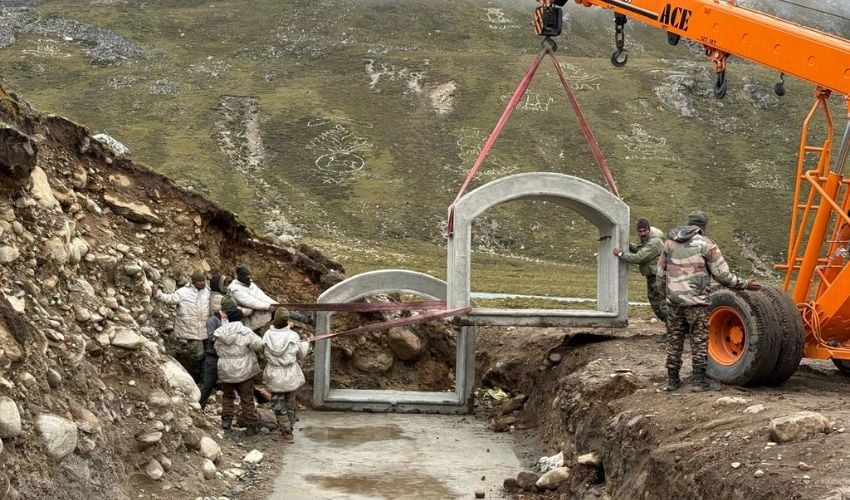
In a notable advancement for military engineering, the Indian Army’s Trishakti Corps has utilized a robotic concrete 3D printer for construction operations in challenging terrains, particularly in northern Sikkim. This innovative initiative enables the Army to execute critical construction projects, including bunkers and sentry posts, directly on-site and under potentially combat conditions.
The printer, which is mobile and mounted on a vehicle, is designed to navigate rugged landscapes while functioning effectively. It features a robotic arm, circular mixer, piston pump, and an onboard generator, allowing for the rapid creation of essential defense infrastructure. To ensure the strength and durability of these structures, the builds underwent live ballistic trials, highlighting the Army’s commitment to testing the efficacy of the technology in real-world conditions.
Traditionally, construction 3D printing is more associated with civilian projects, such as homes or commercial buildings, where its speed and cost-effectiveness are leveraged. However, the priorities differ for defense projects which require specialized designs that cater to the demands of difficult terrains and military specifications.
The initiative falls under Project PRABAL (Portable Robotic Printer for Printing Bunkers and Accessories), developed in collaboration with the Indian Institute of Technology (IIT) Hyderabad. This project has set a precedent in additive manufacturing within military contexts by focusing on utilizing local materials, which facilitates quicker construction that aligns with operational readiness. Furthermore, the printed structures are designed to enhance resistance against blasts and bullets, addressing the unique challenges faced by the Army in high-altitude and low-oxygen environments.
Earlier this year, within the framework of Project PRABAL, the team and Simpliforge Creations successfully completed India’s first on-site 3D printed military-grade protective structure at 11,000 feet in Leh, claiming to build the world’s highest-altitude 3D printed structure.
The adoption of on-site 3D printing significantly improves the Indian Army’s tactical capabilities, ensuring fast, robust, and efficient infrastructure development even in the most adverse conditions. The ongoing commitment to integrate additive manufacturing technologies showcases a leap forward for the Army’s engineering and operational effectiveness.
For more details about the advancements in military additive manufacturing, check the related links: