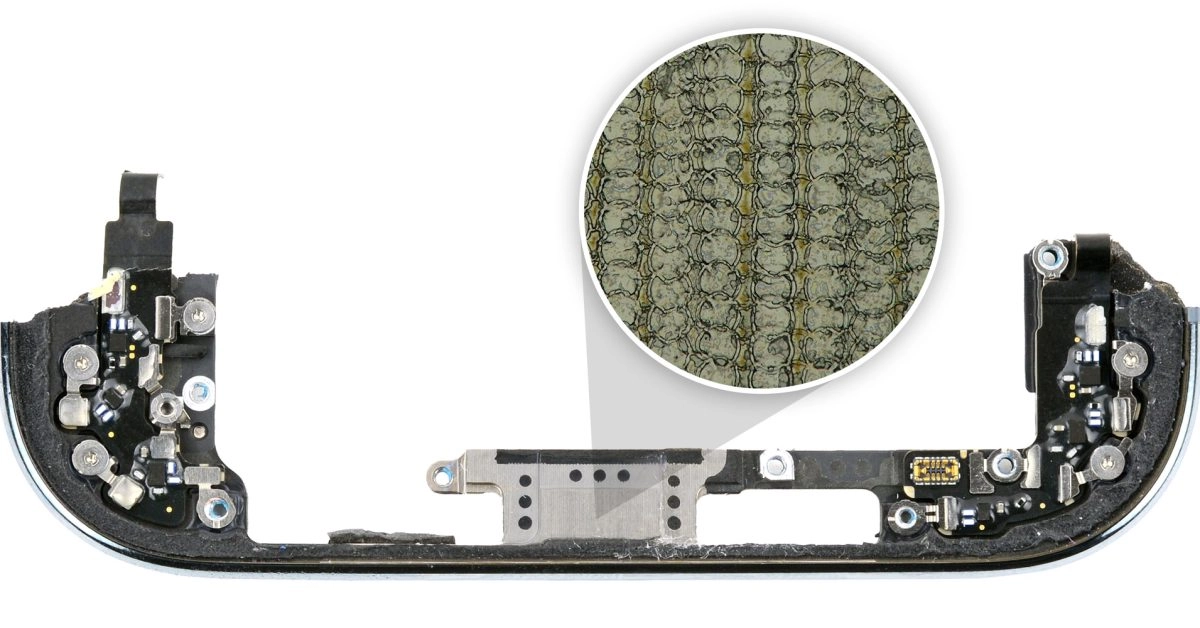
Following Apple’s recent revelations about its 3D printing processes for the Apple Watch Series 11 and Ultra 3, iFixit has delved into the specific techniques used for the new iPhone Air, particularly its 3D-printed USB-C port.
iFixit’s teardown of the iPhone Air highlighted a unique “chainlink-like, circular surface pattern” found at the micro level, which puzzled experienced 3D printing professionals. Initially, there were claims that Apple was relying on a method known as binder jetting—this involves binding a powder to create structures. However, iFixit discovered evidence suggesting a different approach. They noted that Apple appears to have utilized a technique discussed in a medical study from six years ago. This study showcased how pulsed laser ablation could be employed for creating very fine structures on titanium, which had benefits in producing anti-bacterial surfaces for prosthetics.
While the iPhone Air’s USB-C port does not boast any anti-bacterial characteristics, the manufacturing technique aligns with what was described in the medical literature. iFixit also corroborated some details from Apple’s press release, which outlined that multiple laser machines are utilized to build each Apple Watch case from layers of titanium. Although Apple’s description did not officially refer to the process as “pulsed laser ablation,” it ultimately affirmed iFixit’s findings.
This technique is advantageous as it minimizes heating of the surrounding material, preventing warping or discoloration while reducing waste. Furthermore, iFixit took the opportunity to critique Apple’s claim about using “aerospace grade” titanium, clarifying that such a grade does not genuinely exist. They concluded that while the incorporation of 3D printing is exciting, it does not significantly enhance the repairability of the devices, as it is not a straightforward "print-at-home" solution.
For further reading on iFixit’s findings, you can view their detailed assessment here.