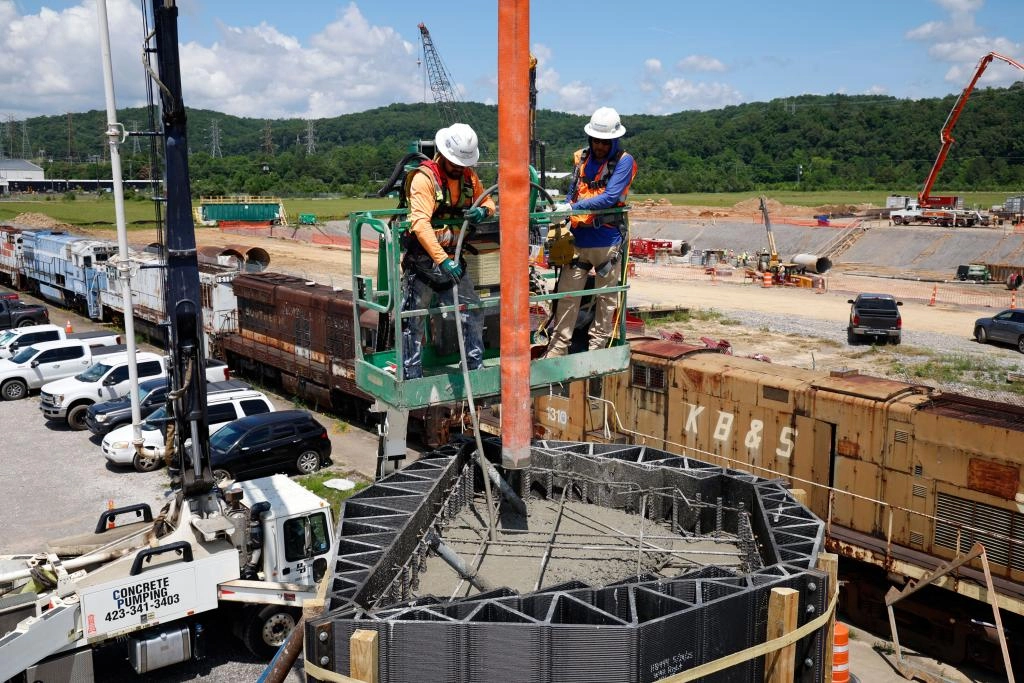
In a groundbreaking initiative, the Department of Energy’s Manufacturing Demonstration Facility (MDF) at Oak Ridge National Laboratory has partnered with Kairos Power and Barnard Construction to innovate the construction of nuclear infrastructure. They have developed large-scale, 3D-printed polymer composite forms designed for casting intricate concrete structures. This method streamlines processes that would typically involve more expensive and time-consuming conventional techniques.
The 3D-printed forms are currently being utilized at Kairos Power’s Oak Ridge campus, where the Hermes Low-Power Demonstration Reactor is under construction, marking a significant step forward for American nuclear energy. The project’s forms measure approximately 10 feet by 10 feet and are assembled in three-unit columns.
A preview of these innovations was showcased at the East Tennessee Economic Council’s Nuclear Opportunities Workshop. The use of 3D-printed molds allows for innovative structural designs, dramatically reducing construction timelines while facilitating the "cast-in-place" method for creating components with unique geometries in just days, instead of weeks.
Ryan Dehoff, director of the MDF, emphasized the potential for modernizing nuclear construction, stating, "We’re combining national lab capabilities with MDF’s legacy… to accelerate new commercial nuclear energy." Over the past decade, MDF has pioneered numerous unique projects, ranging from 3D-printed cars to digital qualifying tools, emphasizing rapid iteration in manufacturing.
Edward Blandford, co-founder and CTO of Kairos Power, highlighted their long-standing relationship with MDF, citing their speed and creativity as pivotal in achieving transformative results. The collaboration aims to refine construction techniques and engage with regulators early on to mitigate risks ahead of scaling.
The Janus column project showcases a novel design for the Hermes bioshield—an essential structure around the reactor that absorbs radiation during operations. The endeavor involved multiple industry partners, including Airtech, TruDesign, and Additive Engineering Solutions, who collectively contributed to establishing a new supply chain for nuclear infrastructure through additive manufacturing.
MDF’s Ahmed Hassen pointed out the technical challenges faced in maintaining the forms’ structural integrity under the heavy pressure of concrete, necessitating innovative design and manufacturing strategies.
This initiative exemplifies the integration of advanced manufacturing into traditional construction sectors, particularly in the nuclear energy field. The SM2ART Moonshot Project, a multi-year initiative involving MDF and the University of Maine, provides backing for these advances by leveraging high-level materials science, supercomputing, and AI resources alongside exceptional 3D printing capabilities.
The projected outcomes hold national significance, as the Knoxville-Oak Ridge region is home to numerous nuclear-focused enterprises, and the Hermes reactor is the first advanced reactor with a construction permit from the U.S. Nuclear Regulatory Commission. With the potential to greatly influence energy demands in the forthcoming decades, the project aims to continue enhancing production methods and implementing smart manufacturing technologies.
For further details, you can visit the Nuclear Opportunities Workshop and learn more about the MDF.